
This post contains affiliate links. As an Amazon Associate, I earn from qualifying purchases at no extra cost to you.
My Top Pick — Thames & Kosmos Green Engineering STEM Kit
Finding the best eco STEM kits for kids in 2026 doesn’t have to be hard — we’ve compared the top options so you don’t have to. If you want one kit that says “start here,” this is it. The Thames & Kosmos Green Engineering kit teaches real concepts — solar panels, water pumps, heat sensors, battery storage — using a working model home that kids actually build themselves. It’s one of the most hands-on introductions to clean energy at this price point, designed for ages 8 and up.
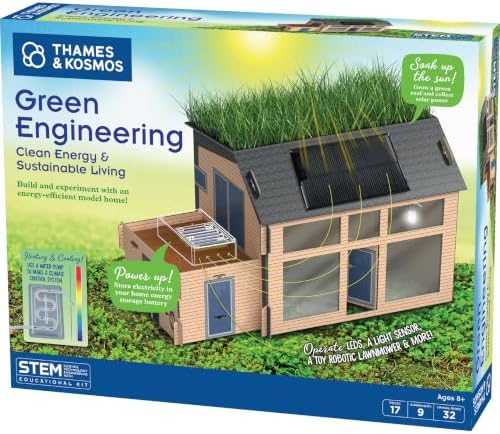
- HANDS-ON LEARNING & DISCOVERY: Kids ages 8 & up can construct a model home with a variety of features that demonstrate d…
- REAL-WORLD MODEL DEVICES: This comprehensive kit includes a solar panel, home energy storage battery, water pump to crea…
- WHAT YOU’LL LEARN: As kids build, experiment, and discover how to supply their model house with renewable energy, they’l…
Best Eco STEM Kits — Quick Comparison


| Product | Price Tier | Best For | Age Range |
|---|---|---|---|
| T&K Green Engineering Kit | Premium | Best overall, clean energy builder | 8+ |
| T&K Wind Power V5.0 | Budget | Best budget, outdoor/indoor turbine | 8+ |
| NatGeo Mega Science Lab | Mid-range | Best variety, 75 experiments | 6+ |
| 4M Solar Robot | Budget | Best starter, no batteries needed | 5+ |
| NatGeo Earth Science Kit | Budget | Best for geology lovers | 6+ |
Reviews — Detailed Breakdown
1. Thames & Kosmos Green Engineering STEM Kit — Best Overall
- HANDS-ON LEARNING & DISCOVERY: Kids ages 8 & up can construct a model home with a variety of features that demonstrate d…
- REAL-WORLD MODEL DEVICES: This comprehensive kit includes a solar panel, home energy storage battery, water pump to crea…
- WHAT YOU’LL LEARN: As kids build, experiment, and discover how to supply their model house with renewable energy, they’l…
Key Specs
- Age range: 8 and up
- Components: Solar panel, water pump, LEDs, heat sensor, robotic lawnmower, battery storage
- Experiment count: 17 experiments, 9 sensors, 32 components
- Price tier: Premium
Who this is for: Kids 8–12 who are genuinely curious about how energy works — not just making things blink, but understanding why. Also great for parents who want to introduce climate concepts without a lecture.
Parents often say the box looks intimidating at first — there are a lot of pieces — but the full-color instruction manual walks through each step clearly, and owners report getting a working solar-powered model house with functioning LEDs and a tiny water pump running off a rooftop panel in about 45 minutes. Reviewers often mention kids spending another hour experimenting with what happens when they cover the solar panel, adjust the tilt, or swap out the battery storage. That’s the kind of organic learning no worksheet produces.
The real strength here is the variety of systems in one kit. You’re not building a single robot and calling it done. You’re experimenting with solar collection, heat sensors, water management, and energy storage — separately and together. Each system reinforces the others in a way that builds actual systems thinking. Of the STEM kits we’ve compared, this one has the best concept-to-activity ratio in its price range.
What we like:
- Solar panel, water pump, heat sensor, and battery storage all work together — not isolated experiments
- Full-color 40+ page instruction manual is actually readable and interesting
- Robotic lawnmower powered entirely by the sun is a crowd-pleaser kids keep coming back to
- Durable plastic components that hold up to repeated assembly and disassembly
What could be better:
- Premium tier — the most expensive kit on this list, not an impulse buy
- Setup takes 30–45 minutes before the first experiment; younger kids may need adult help at the start
- Some components are small — recommended 8+ is accurate, not just legal boilerplate
Bottom line: If you can swing the price, this is the one kit that keeps giving. It’s not just educational — it’s genuinely engaging over multiple sessions.
2. Thames & Kosmos Wind Power V5.0 — Best Budget Pick
- FIFTH-GENERATION WIND TURBINE KIT: Updated version of the best-selling STEM kit about wind power and energy, kids can ma…
- OPTIMIZED FOR INDOOR & OUTDOOR USE: Design includes a new blade hub and gear ratio to enhance performance in outdoor win…
- WHAT YOU LEARN: Dive into the technology behind one of the most promising sources of clean energy, how it has been used …
Key Specs
- Age range: 8 and up
- Build: 3-foot working wind turbine with adjustable blades
- Output: Charges a small battery, powers an LED, drives a model car
- Indoor/outdoor: Both (weatherproof generator)
- Price tier: Budget
Who this is for: Kids who want to build something big and watch it actually work. As a budget-tier kit, this is one of the best-value renewable energy kits available — and the V5.0 version has improved blade aerodynamics that work better in low-wind indoor environments.
Compared with the previous V4.0 version, this V5.0 is a meaningful upgrade on paper. The blades are longer and more curved, and owners report even a decent desk fan can drive the turbine. You build a realistic three-blade turbine with a sturdy ground stake, wire it to a generator that lights an LED or charges a small AA battery, and then convert the whole thing into a tiny electric car when you’re done with wind experiments.
The 32-page full-color manual is excellent — it explains how the sun creates wind through thermal dynamics before getting into the build, which gives kids actual context rather than just step 1, step 2. Parents often mention kids reading the intro section on their own, unprompted. That doesn’t happen with most kits.
What we like:
- Updated aerodynamic blade design generates power at lower wind speeds than previous versions
- Converts into an electric car to demonstrate energy storage application — two builds in one
- Ground stakes for outdoor use; generator is weatherproof
- 32-page manual ties the science to real-world wind energy applications
What could be better:
- Requires a rechargeable AA battery (not included) to demonstrate energy storage
- At 3 feet tall, requires some table or yard space to run properly
- LED demonstration is low-key; kids expecting dramatic output may need expectation management
Bottom line: For a budget-tier price, this is genuinely the best value on this list. You build something that looks impressive, works outdoors, and demonstrates two forms of clean energy in one package.
3. National Geographic Mega Science Lab — Best All-in-One
- THREE SCIENCE KITS IN ONE – This kit contains 45 of our most popular Earth science, chemistry, and science magic experim…
- EXPLORE EARTH SCIENCES – Kids will build and erupt a volcano, grow a glow in the dark crystal, create water tornadoes, a…
- DIVE INTO CHEMISTRY – The chemistry set in this kit has everything kids need to make gooey worms and worm eggs, create b…
Key Specs
- Age range: 6 and up
- Experiments: 75 easy experiments (earth science, chemistry, science magic)
- Includes: Full-color learning guide with scientific explanations
- Price tier: Mid-range
Who this is for: Younger kids (6–9) who are just getting into science and need variety over depth. Also works well as a shared kit for siblings — there’s enough content for multiple kids across multiple sessions.
What parents mention most about the NatGeo Mega Science Lab is how much kids understand afterward, not just what they did. The included Learning Guide explains why a volcano erupts, why crystals grow the way they do, why certain liquids separate. Most science kits at this price point skip the explanation and just let kids make messes. This one treats the science as the actual point.
The 75 experiments span earth science (volcanoes, crystal growing, rock identification), chemistry (invisible ink, color-changing reactions, density towers), and science magic — which is just physics presented in a way that makes kids feel like they’re doing something impossible. Reviewers often describe kids coming back to the crystal-growing experiment multiple times, adjusting variables each time. That’s real scientific thinking happening.
What we like:
- 75 experiments is genuinely a lot — this lasts months, not a weekend
- National Geographic Learning Guide explains the underlying science in accessible language
- Earth science angle (geology, weather, chemistry) is genuinely eco-relevant
- Consistently strong owner feedback — reliable quality from a well-known brand
What could be better:
- Some consumable materials will run out; replacements are findable online but add cost
- The “science magic” experiments feel less rigorous than the earth science ones
- At this price, you’re paying for breadth, not depth — it won’t go deep on any one topic
Bottom line: The best choice if you want something that lasts multiple sessions. The NatGeo name means quality materials and real educational content.
4. 4M Green Science Solar Robot — Best Starter Kit
- SOLAR-POWERED MOTION: Build a walking robot that uses sunlight to move, showcasing renewable energy with no batteries ne…
- ADJUSTABLE SOLAR PANEL: Learn how to make a moving robot using solar panel and a motor. Learn energy conversion and prop…
- TRANSPARENT GEARBOX: A clear gearbox reveals the mechanics and gears in action, making the learning process visual and e…
Key Specs
- Age range: 5 and up
- Build: DIY walking robot powered by solar panel only
- Batteries: None required — solar only
- Assembly time: 20–30 minutes
- Price tier: Budget
Who this is for: Younger kids just starting with STEM, or parents who want a quick weekend build without a big commitment. Also great as a gift for a curious 5–8 year old.
The 4M Solar Robot is the most straightforward kit on this list. You build a small walking robot from plastic parts, attach the solar panel, set it in sunlight, and watch it move with no batteries whatsoever. The transparent gearbox is the clever touch — you can see every gear turning as the robot walks, so kids immediately understand the connection between sunlight, motor, and movement without anyone explaining it.
Parents report younger kids can assemble this one themselves with minimal help, and the instruction steps are clear enough for a 6-year-old to follow with light adult supervision. It’s not a complex experiment kit — it’s a single focused build that demonstrates one principle very clearly. Sometimes that focus is exactly what a younger kid needs before diving into a bigger multi-experiment kit.
What we like:
- Zero batteries — solar-only operation makes the energy concept impossible to miss
- Transparent gearbox lets kids see the mechanical motion as it happens
- 20–30 minute build is achievable in one sitting without frustration
- Lowest price tier on this list for a brand-name kit with actual scientific value
What could be better:
- Designed for direct sunlight; works indoors near a bright window, but performance varies
- Single build with one concept — not a multi-session kit
- Small parts require adult supervision for children under 5
Bottom line: The best entry-level eco STEM kit on this list. Build it, put it in the sun, watch a kid’s face when it starts walking on its own.
5. National Geographic Earth Science Kit — Best for Geology Fans
- MASSIVE SCIENCE KIT FOR CURIOUS KIDS – More than 15 experiment activities including dueling water tornadoes, building an…
- ENOUGH TO GO AROUND – This science lab allows kids to conduct multiple experiments and is great to share with family, fr…
- THE SECRET IS THE SCIENCE – A detailed, full-color Learning Guide teaches the science at work in the experiments, allowi…
Key Specs
- Age range: 6 and up
- Activities: 100+ experiments and activities
- Included extras: Real gemstones — selenite, obsidian, pyrite, tiger’s eye, desert rose
- Price tier: Budget
Who this is for: Kids fascinated by rocks, minerals, geology, and the natural world. If your child has ever picked up a random rock and asked what it is, get this kit.
The NatGeo Earth Science Kit takes a different angle from the energy-focused kits on this list — it’s about understanding the earth itself. You grow crystals (in as little as 3 days), build and erupt a volcano with multiple formula variations, and start a real rock collection using actual gemstone specimens included in the kit. The included specimens — selenite, obsidian, tiger’s eye, desert rose and more — are real minerals, not plastic replicas.
What stands out about this kit is that it’s built to create lasting interest, not just a one-time reaction. Parents often describe kids keeping the rock collection going long afterward, adding specimens they find hiking, looking them up and writing labels. That’s the kind of natural curiosity a good STEM kit should ignite and leave burning. For a budget-tier kit, the value is exceptional — real mineral specimens bought separately would add up quickly.
What we like:
- Real mineral specimens (not plastic) — selenite, obsidian, pyrite, tiger’s eye, desert rose
- Crystal-growing formula works in 3 days — fast enough to maintain a child’s attention
- Multiple volcano reaction formulas to experiment with, not just one demonstration
- 100+ activities covers months of exploration
What could be better:
- Geology angle is less directly eco-focused than solar/wind kits
- Some consumable materials deplete; volcano powder runs out faster than you’d like
- The dig bricks can be messy — plan for an outdoor or easy-clean setup
Bottom line: If your kid is the one who stops on every hike to pick up rocks, this is the kit. Real specimens, real science, and 100+ experiments that last.
How to Choose an Eco STEM Kit: What Actually Matters
Age Fit vs. Stated Age Range
Most manufacturers list a conservative age range to avoid complaints, which means “8 and up” on a Thames & Kosmos kit is usually fine for a 7-year-old with adult support, while “5 and up” on a 4M kit is genuinely achievable for a five-year-old working mostly independently. Look at the build complexity description more than the age number. A 10-year-old who’s new to building will struggle with the Green Engineering kit without help; a 7-year-old who loves taking things apart will handle it fine.
The practical rule: if the child does homework independently and can follow multi-step instructions, they can handle most kits rated 8+. If they still need help with reading, stick with the 4M Solar Robot or the NatGeo kits, which lean more visual and tactile.
Single Concept vs. Multi-Experiment Kits
Budget-tier kits tend to be focused single-concept builds — the 4M Solar Robot and NatGeo Earth Science Kit both demonstrate 1–3 core principles with multiple variations. Great for keeping interest without overwhelming. Premium kits get you multi-system builds where different concepts connect to each other. The Thames & Kosmos Green Engineering kit falls here — they’re not just bigger, they’re more integrated, and that integration produces better understanding.
Don’t automatically assume bigger is better. A child who builds the 4M Solar Robot and genuinely understands how solar panels work is better positioned than one who muddles through the Green Engineering kit and just follows steps.
Replayability and Long-Term Value
The single biggest predictor of whether a STEM kit gets used beyond the first weekend is whether it has consumable materials you can replenish. The crystal-growing and volcano kits from NatGeo use simple chemistry replenishable with grocery store items — baking soda, citric acid, alum. The engineering kits don’t consume anything — the 4M Solar Robot and the Thames & Kosmos Wind Turbine can be built, disassembled, and rebuilt indefinitely.
If budget is a concern, the build-based engineering kits offer the best long-term value because nothing runs out. If your kid is a chemistry-leaning experimenter, the NatGeo kits are worth the ongoing consumable cost.
See full specs on Thames & Kosmos’s official product page
If you’re exploring more STEM options, see our roundup of the best AI STEM toys for kids — a great complement to these eco kits for tech-curious learners.
Related STEM Guides for Kids
- Best Science Kits for Kids — more budget-friendly experiments
- Best Rock Tumbler for Kids — real earth science at home
- Best Electronics Kits for Kids — circuits and solar power
Frequently Asked Questions
What’s the best eco STEM kit for a 7-year-old?
The NatGeo Mega Science Lab is the safest bet for 7-year-olds — the experiments are accessible, the materials are clearly labeled, and the Learning Guide gives context without overwhelming young readers. For kids who love building physical things, the 4M Solar Robot is a satisfying 20–30 minute build that produces a genuinely cool result.
Are these STEM kits safe for kids to use without adult supervision?
It depends on the kit and the child’s age. The 4M Solar Robot (ages 5+) and NatGeo Earth Science Kit (ages 6+) are designed for independent use by kids who can follow multi-step instructions. The Thames & Kosmos Green Engineering kit involves more complex assembly — adult supervision at the start is genuinely helpful. None of these kits involve dangerous chemicals or electricity beyond low-voltage solar/battery current.
Do eco STEM kits actually teach kids about climate and sustainability?
The best ones do, yes — and more effectively than any lecture. When a child builds a wind turbine that charges a battery or constructs a solar-powered model home with water management, they understand intuitively why renewable energy works. The Thames & Kosmos Wind Power V5.0 manual explains the physics of how wind forms before any building begins. That context makes the hands-on activity meaningful rather than just mechanical.
Are eco STEM kits worth it in 2026?
Yes — if you match the kit to the child. The kits on this list are from established brands with real quality control, addressing a growing interest in environmental science that schools are increasingly emphasizing. The value case is strongest for the 4M Solar Robot and T&K Wind Power V5.0 at the budget end, and the T&K Green Engineering Kit for the full integrated experience.
Looking to make your home more energy-smart alongside STEM learning? Check out our picks for the best smart plugs with energy monitoring — a great real-world complement to the concepts these kits teach.
Final Verdict
For most kids ages 8–12, the Thames & Kosmos Green Engineering STEM Kit is the clear best choice — it’s the most educational, the most replayable, and the one most likely to spark lasting curiosity about how clean energy actually works. If that’s more than you want to spend right now, the budget-tier Thames & Kosmos Wind Power V5.0 delivers exceptional value and still builds something genuinely impressive. Younger kids (5–7) will get the most from the 4M Solar Robot as a first exposure to solar energy, and the NatGeo Mega Science Lab is the best call if you want months of variety over focused depth.
No layout selected.Last updated: May 2026 | Prices subject to change.
Questions about any of these picks? Get in touch via our contact page.
Pingback: Best Science Kits For Kids Under $50 In 2026