
This post contains affiliate links. As an Amazon Associate, I earn from qualifying purchases at no extra cost to you.
Burying a perimeter wire around your whole yard is the part of robot mowing nobody enjoys. You rent an edging tool, pin a few hundred feet of cable into the turf, and then spend the next summer hunting for the break after an aerator or a curious dog snaps it. The best robot lawn mower without perimeter wire skips all of that: you drive it around the edge once with your phone, it builds a map, and the boundary lives in software instead of in the dirt.
The catch is that “wire-free” covers three very different navigation systems — satellite RTK, LiDAR and camera vision — and each one behaves differently under trees, beside a tall fence or on a steep bank. We compared five wire-free mowers from Segway Navimow, ECOVACS and Mammotion using the spec sheets, the manufacturers’ published coverage and slope figures, and what verified owners report after a season of use. Below you’ll find which one fits a small suburban lot, which one handles shade, and which one is worth the premium for hills and big acreage.
My Top Pick — Segway Navimow i105N
For most small yards, the Navimow i105N is the easiest way into wire-free mowing. It pairs RTK satellite positioning with a 140° vision camera, maps the lawn almost automatically, and costs far less than the LiDAR and all-wheel-drive models further down this list. If your lawn is under about 5,400 sq ft and not heavily shaded, it’s the one I’d buy first.

- RTK+Vision, Fit into Every Garden: Lawn covered by trees? Narrow corridor? However complicated your garden layout is, en…
- No Perimeter Wires & Automatic AI-assisted Mapping: Quick, wire-free setup in just a few taps, simply use your smartphon…
- Efficient Flawless Lawn Maintenance: Navimow mows your lawn with planned mowing patterns to ensure systematic and effici…
Best Robot Lawn Mower Without Perimeter Wire — Quick Comparison


Ratings are Amazon customer averages at the time of writing. Live prices appear in the product boxes.
Reviews — Detailed Breakdown
1. Segway Navimow i105N — Best Overall for Small Yards
- RTK+Vision, Fit into Every Garden: Lawn covered by trees? Narrow corridor? However complicated your garden layout is, en…
- No Perimeter Wires & Automatic AI-assisted Mapping: Quick, wire-free setup in just a few taps, simply use your smartphon…
- Efficient Flawless Lawn Maintenance: Navimow mows your lawn with planned mowing patterns to ensure systematic and effici…
Key Specs
- Navigation: RTK satellite positioning + 140° vision camera (EFLS 2.0)
- Rated area: up to 0.125 acre (about 5,400 sq ft)
- Cutting width: 7.1 in
- Obstacle recognition: 150+ object types via AI camera
- Zones: up to 12, each with its own schedule and mowing direction
- Noise: 58 dB(A) · Weight: 24 lb
Who this is for: Homeowners with a small, mostly open front or back lawn who want the lowest-friction way to stop pushing a mower.
The i105N is the model that made wire-free mowing affordable, and it still sets the bar for setup. Instead of walking the boundary with a remote for an hour, you start the AI-assisted mapping in the Navimow app and the mower traces the visible edge of your grass on its own, stopping where it sees pavement, mulch or a flower bed. You correct the corners it got wrong and the map is done. Owners consistently describe first-day setup as the part that surprised them most, because they’d budgeted a weekend for it.
Under the hood it relies on RTK — the same centimeter-level satellite correction surveyors use — with a camera filling in when a tree or the side of the house blocks the sky. That combination is why Segway can promise it works “under the trees or in a narrow corridor,” but it’s also its limit. RTK needs a reference antenna with a clear view of the sky, and in heavily shaded lots owners report the mower occasionally pausing to re-acquire its position. A side yard between two houses is usually fine; a backyard under a full oak canopy is where you should look at the LiDAR models below instead.
Mowing itself is methodical rather than random. It cuts in planned parallel stripes, changes direction after each full pass so you don’t get ruts, returns to charge when needed and resumes where it stopped. The 7.1-inch cutting width is narrow, so on a 5,000 sq ft lawn it works in shorter, frequent sessions — which is how robot mowers are meant to run anyway. You set it to mow a little every day or two and the grass never gets long enough to need bagging.
If you live on a small suburban lot with a mostly open lawn, this is the sweet spot: a capable, quiet mower that won’t wake the neighbors at 58 dB and costs well under the premium tier.
What I liked:
- Fastest setup of the group thanks to AI-assisted mapping — no boundary walking for most lawns
- Planned stripe patterns with automatic direction changes keep the lawn looking cut, not chewed
- Up to 12 zones means front and back yard can run different schedules
What could be better:
- RTK antenna needs open sky; dense shade can cause positioning pauses
- Only rated to 1/8 acre — bigger lawns need a step-up model
Bottom line: The best robot lawn mower without perimeter wire for small, open yards — and the cheapest way into the category from a major brand.
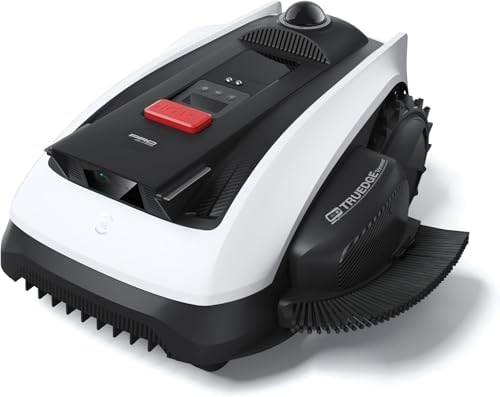
2. ECOVACS GOAT O1000 LiDAR PRO — Best for Yards with Trees
- Wire-Free Robotic Lawn Mower with LiDAR Navigation – GOAT O1000 LiDAR PRO is a wire-free robotic lawn mower that require…
- Built-In Edge Trimming for Clean Borders – Unlike standard robot lawn mowers, this model features an integrated TruEdge …
- Advanced 3D Obstacle Detection for Safer Mowing – Powered by AI Vision and 3D ToF LiDAR, GOAT O1000 LiDAR PRO accurately…
Key Specs
- Navigation: HoloScope 360° dual LiDAR — no perimeter wire and no RTK antenna
- Positioning accuracy: about 2 cm (manufacturer figure)
- Rated area: up to 1/4 acre
- Edge cutting: built-in TruEdge string trimmer
- Obstacle avoidance: AI vision + 3D ToF, 200+ object types, 5 cm detection precision
- Sold and shipped by Amazon.com at the time of writing
Who this is for: Anyone whose lawn sits under trees, beside a two-story house or along a tall privacy fence — the places where satellite mowers struggle.
The O1000 LiDAR PRO takes the opposite approach to the Navimow. There’s no RTK antenna to plant in the yard at all. Two spinning LiDAR sensors on top of the mower measure distances to everything around it — the fence, the tree trunks, the house wall — and build a 3D point cloud it uses to know where it is. Because it never needs to see a satellite, shade simply doesn’t matter. This is the single biggest reason to pick LiDAR over RTK, and it’s why we’d point anyone with mature trees here first.
The second standout is the TruEdge trimmer. Most robot mowers leave a strip of uncut grass a few inches wide along walls and beds because the blade disc sits inside the body. ECOVACS bolts a small string trimmer to the side that runs along driveways and borders, so the weekly job of running a string trimmer around the lawn shrinks to an occasional tidy-up. ECOVACS itself notes that tight corners and raised edges may still need manual trimming, and owners agree — but the reduction is real.
Obstacle handling is the other place it earns its price. A combination of AI vision and a 3D time-of-flight sensor identifies more than 200 object types, from garden hoses to kids’ toys, and keeps a small clearance around them. If you have young children or a dog who leaves things on the lawn, that matters more than any cutting spec.
The trade-off is weight and bulk: the O1000 is a heavier machine than the Navimow, and setup still involves a few rounds of tweaking zones in the app. Owners in reviews mention needing a couple of mapping adjustments in the first week before it settles in.
What I liked:
- No RTK antenna — shade, tall fences and tree cover don’t affect positioning
- Built-in edge trimmer cuts most of the border work you’d otherwise do by hand
- Strong obstacle detection for yards with kids, pets and garden clutter
What could be better:
- Initial zone setup can take some fine-tuning
- Rated to 1/4 acre; bigger yards should look at the A2000
Bottom line: If trees are the reason you’ve hesitated on a wire-free mower, the O1000 LiDAR PRO is the answer.
3. ECOVACS GOAT A2000 LiDAR PRO — Best for Half-Acre Lawns
- Wire-Free Robotic Lawn Mower with LiDAR Navigation – GOAT A2000 LiDAR PRO is a wire-free robotic lawn mower that require…
- Built-In Edge Trimming for Clean Borders – Unlike standard robot lawn mowers, this model features an integrated TruEdge …
- High-Power 32V Platform for Thick Grass – Designed for American lawns with Bermuda, Zoysia, Fescue, and St. Augustine gr…
Key Specs
- Navigation: HoloScope 360° dual LiDAR — no wire, no RTK antenna
- Rated area: up to 1/2 acre
- Power: 32V platform with dual-blade disc for thick grass
- Battery: 3.0Ah, 113.4W fast charging (about 50 minutes to recharge)
- Edge cutting: TruEdge trimmer (2 rolls of line included)
- Sold and shipped by Amazon.com at the time of writing
Who this is for: Owners of a quarter- to half-acre lawn, especially with dense warm-season grasses like Bermuda, Zoysia or St. Augustine.
The A2000 is the bigger sibling of the O1000, with the same LiDAR navigation and edge trimmer but built for twice the area. The headline upgrade is the 32V drive and cutting platform. ECOVACS designed it specifically for American lawns, and it shows in the grass types it calls out: Bermuda and St. Augustine grow thick and fast in summer, and a weak cutting motor ends up bogging down or leaving tufts. More torque at the blade disc is what keeps a half-acre lawn looking even through July.
Charging speed is the quiet advantage here. A 50-minute recharge on a 3.0Ah pack means the mower spends more of its day cutting and less of it parked in the dock, which is how it keeps up with a larger lawn without a giant battery. Owners with half-acre lots report it can stay on top of the grass on a daily schedule through peak season.
Like the O1000, it doesn’t need a clear view of the sky, so a large lawn ringed by trees is a natural fit. It’s a heavy unit at roughly 60 lb shipped, so plan where the dock goes before it arrives — ideally a flat spot near an outdoor outlet.
If your lawn is larger than about 10,000 sq ft and not especially hilly, the A2000 gives you most of what the premium Mammotion models offer for noticeably less money.
What I liked:
- Half-acre coverage with the same shade-proof LiDAR navigation
- 32V cutting platform aimed at thick warm-season grasses
- Fast 50-minute recharge keeps it mowing more of the day
What could be better:
- Not built for steep slopes like the all-wheel-drive LUBA models
- Heavy and bulky to move between front and back yards
Bottom line: The value pick for half-acre lawns, especially if trees rule out RTK.
4. Mammotion LUBA 3 AWD 3000 — Best for Steep Slopes
- What’s in the Box: 1*LUBA 3 AWD 3000, 1*Charging Station, 1*Product Guide, Extra One Set of Blades
- Tri-Fusion Navigation Technology: Integrating 360° LiDAR, NetRTK, and Dual-Camera AI Vision, Mammotion LUBA 3 AWD sets a…
- Off-Road Performance: With four independently motors, the Mammotion LUBA 3 AWD climbs slopes up to 80% (38.6°) with ease…
Key Specs
- Navigation: Tri-Fusion — 360° LiDAR + NetRTK + dual-camera AI vision
- Drive: all-wheel drive with four independent motors, rated for 80% (38.6°) slopes
- Obstacle clearance: steps over curbs and roots up to 50 mm
- Cutting: two 165W motors with 6-blade discs, 40 cm cutting width, 1.0–2.7 in height
- Throughput: up to 5,400 sq ft per hour · battery up to 12Ah
Who this is for: Homeowners with hillsides, terraced lawns or rough, uneven ground that would strand an ordinary two-wheel robot.
Most robot mowers are rated for slopes somewhere around 35–50%. The LUBA 3 AWD is rated for 80%, which is steeper than most people would comfortably push a mower up. Four independently driven wheels, an omni wheel for pivoting and adaptive suspension let it climb, turn and step over roots or a curb up to 50 mm high without getting beached. If your yard has a bank down to a ditch or a hill you currently mow sideways with a string trimmer, this is the category that solves it.
Navigation uses all three wire-free methods at once. LiDAR with a 230 ft range builds a dense map of the yard, NetRTK provides satellite corrections without you installing a separate base antenna, and the dual cameras handle object recognition. The mower switches between sensors automatically, so it isn’t stuck when one of them struggles — the LiDAR carries it under trees, and RTK keeps it accurate in wide-open stretches where there’s little for the laser to reference.
Cutting power is the other leap. Two 165W motors with six-blade discs give it a 40 cm swath, roughly double the Navimow’s, and the AI vision adjusts motor speed to grass density. That’s what lets it cover up to 5,400 sq ft an hour on a large lawn.
The obvious downside is cost: it sits firmly in the premium tier, and it’s more machine than a flat quarter-acre needs. Owners also note that a mower this capable takes some time to dial in — zones, cutting height and schedule all have more options to tune.
What I liked:
- 80% slope rating and AWD — handles terrain other robot mowers can’t
- LiDAR + NetRTK + vision means no single weak spot in navigation
- Wide 40 cm cut covers big areas quickly
What could be better:
- Premium price is hard to justify on a small flat lawn
- Lots of settings to learn compared with simpler models
Bottom line: If hills are your problem, this is the wire-free mower built for them.
5. Mammotion LUBA 2 AWD 5000HX — Best for Large Properties
- Unbeatable Off-road Capacity: With a powerful 165 W four-wheel motor provides exceptional driving capabilities, allowing…
- Smart Features for Effortless Lawn Care: The UltraSense AI Vision combined with the RTK navigation system ensures mow un…
- Maximum 13000 sq.ft (1200㎡) Per Charge: Featuring a unique dual-blade disk design with a cutting width of up to15.8″ (40…
Key Specs
- Navigation: RTK + UltraSense AI vision (mows under trees without satellite signal)
- Rated area: up to 1.25 acres · up to 13,000 sq ft per charge
- Drive: all-wheel drive, rated for 80% (38°) slopes
- Cutting width: up to 15.8 in (400 mm), dual-blade disc
- Zones: up to 50 mowing areas, plus no-go zones
- Connectivity: 4G, Bluetooth and Wi-Fi · includes cleaning stand
Who this is for: Owners of an acre-plus property with multiple separate lawns, long driveways and areas the mower has to travel between.
The LUBA 2 AWD 5000HX is the largest mower here and the one with the most verified reviews of the group. Its 1.25-acre rating and 13,000 sq ft per charge put it in a different league from the small-yard models, and it pairs that coverage with the same 80% slope capability as the LUBA 3. On a big rural or semi-rural lot with a few hills, that combination is what actually replaces a riding mower for routine cuts.
The 4G connection is more useful than it sounds. Large properties often have dead Wi-Fi spots at the far end of the lawn, and with a cellular link you can still check status, see where it is and get alerts. Mammotion pairs that with up to 50 zones, so the front lawn, back lawn, orchard strip and side yard can each have their own schedule, cutting pattern and direction — and the mower crosses between them on paths you define.
Navigation here is RTK plus Mammotion’s UltraSense AI vision, which lets it keep mowing under trees when the satellite signal drops. It’s not quite as shade-proof as the pure-LiDAR ECOVACS models, but on a large open property RTK is extremely accurate and the vision system covers the shaded edges. Owners highlight the zero-distance edge cutting along paths and beds as a major time saver.
The caveats are size and price. It’s a premium purchase, and on anything under half an acre you’re paying for capacity you won’t use.
What I liked:
- 1.25-acre rating and 13,000 sq ft per charge for large properties
- 4G connectivity and 50 zones suit spread-out multi-lawn properties
- AWD and 80% slope rating for hilly acreage
What could be better:
- RTK relies on open sky for best accuracy; heavy tree cover leans on the vision system
- Overkill for typical suburban lots
Bottom line: The pick for acre-plus properties that want a robot to handle every routine cut.
How to Choose a Mower Without Perimeter Wire: What Actually Matters
RTK vs LiDAR vs Vision Navigation
This is the decision that matters most, and it comes down to how much sky your lawn can see. RTK (Real-Time Kinematic) corrects GPS to within a couple of centimeters, but it needs satellite visibility. It’s excellent on open lawns and the most accurate option over long distances. LiDAR uses laser distance sensors to map fixed objects around the yard, so it works under trees and next to buildings but can have less to reference in a wide, featureless field. Vision uses cameras to read where the grass ends — great for edges and obstacles, weaker in low light.
A practical rule: if more than a third of your lawn is under tree canopy or beside a tall wall, lean toward LiDAR (the ECOVACS GOAT models) or a hybrid (the LUBA 3). If your lawn is mostly open, RTK models like the Navimow i105N and LUBA 2 are accurate and simpler.
Rated Lawn Size — Buy Some Headroom
Manufacturer ratings assume ideal conditions: flat ground, regular mowing, no complex zones. Real yards with slopes, narrow passages and multiple zones eat into that number. Choose a model rated for at least 20–30% more area than you actually have. A 4,500 sq ft lawn is comfortably inside the i105N’s 1/8-acre rating; a 9,000 sq ft lawn should go to the 1/4-acre class, not squeeze into the smaller one.
Slopes and Terrain
Two-wheel-drive robot mowers lose traction on wet banks and can get stuck on roots. If any part of your yard is steeper than a gentle grade, or you have bumps, curbs or ruts the mower must cross, the all-wheel-drive Mammotion LUBA models are the only ones here built for it. Check your steepest section before you buy — a smartphone level app held on a board laid on the slope gives a quick reading.
Edge Cutting and Obstacle Avoidance
Every robot mower leaves some uncut grass at edges. Models with a dedicated edge trimmer (ECOVACS TruEdge) or “zero-distance” edge modes (Mammotion) shrink that strip a lot. For safety, look for camera or 3D obstacle recognition with a large object library; all five picks here identify 150–200+ object types, which matters if kids or pets use the yard.
Connectivity, Theft Protection and Weather
Wi-Fi rarely reaches the far corner of a big lawn. Cellular (4G) connectivity, offered on the LUBA 2 AWD 5000HX and as an option on Navimow, keeps the app working anywhere on the property and helps locate the mower if it’s taken. Also plan the dock location: a level spot near an outdoor outlet, ideally under an eave or a mower garage to keep the worst rain and sun off it.
Running Costs
Budget for replacement blades every few months of heavy use, and on ECOVACS models, trimmer line. Electricity costs are small — robot mowers draw far less over a season than a gas mower burns in fuel. If you want to see exactly what your dock uses, an energy-monitoring smart plug will log it.
Frequently Asked Questions
Do robot lawn mowers without perimeter wire really work?
Yes. Modern wire-free mowers use RTK satellite positioning, LiDAR or camera vision to build a virtual boundary, and owners of current models report reliable mowing once the map is set up. The main failures come from choosing the wrong navigation type for the yard — for example, an RTK-only mower under heavy tree cover.
Which is better for a robot mower, RTK or LiDAR?
RTK is more accurate across large open lawns; LiDAR works better under trees and beside buildings because it doesn’t need a clear view of the sky. Hybrids like the Mammotion LUBA 3 AWD combine both. Pick based on how much of your lawn is shaded.
Do wire-free robot mowers work under trees?
LiDAR models like the ECOVACS GOAT O1000 and A2000 LiDAR PRO work under trees because they navigate by mapping nearby objects. RTK models can lose accuracy under thick canopies, though vision-assisted systems such as Navimow’s EFLS 2.0 and Mammotion’s UltraSense help fill the gaps.
How big a lawn can a robot mower handle?
It depends on the model. In this guide, ratings range from 1/8 acre (Navimow i105N) to 1.25 acres (Mammotion LUBA 2 AWD 5000HX). Buy a model rated for 20–30% more than your actual lawn to allow for slopes and multiple zones.
Can robot lawn mowers handle hills?
Standard robot mowers manage moderate slopes, but steep banks need all-wheel drive. Both Mammotion LUBA AWD models here are rated for 80% slopes, the highest of the group.
Do robot mowers get stolen?
It’s uncommon but possible. Most wire-free mowers require a PIN, are tied to your app account, and many offer GPS or 4G tracking so you can locate them. Placing the dock out of sight from the street helps too.
Can a robot lawn mower stay out in the rain?
Most are designed to live outdoors and handle light rain, and many pause automatically in wet conditions to protect the turf. Check each model’s weather rating and consider a mower garage to protect the dock and extend its life.
How long does it take to set up a wire-free robot mower?
Typically under an hour for a simple lawn: place the dock (and RTK antenna if needed), connect the app, then map the boundary. The Navimow i105N’s AI-assisted mapping is the quickest here; models with many zones take longer to fine-tune.
Is a robot lawn mower without perimeter wire worth it in 2026?
Yes, if you value your weekend time and your lawn fits the model’s rating. Wire-free mowers remove the most frustrating part of robot mowing — installing and repairing buried cable — and mow little and often, which keeps grass healthier. They’re not worth it for very small or extremely complex yards with lots of narrow strips.
Final Verdict
For most small suburban yards, the Segway Navimow i105N is the best robot lawn mower without perimeter wire: quick to set up, accurate on open lawns and the most affordable of the group. If trees are your problem, the ECOVACS GOAT O1000 LiDAR PRO skips satellites entirely, and its bigger sibling the GOAT A2000 LiDAR PRO covers half an acre of thick grass. For hills, the Mammotion LUBA 3 AWD 3000 is in a class of its own, and the LUBA 2 AWD 5000HX is the choice for acre-plus properties.
- RTK+Vision, Fit into Every Garden: Lawn covered by trees? Narrow corridor? However complicated your garden layout is, en…
- No Perimeter Wires & Automatic AI-assisted Mapping: Quick, wire-free setup in just a few taps, simply use your smartphon…
- Efficient Flawless Lawn Maintenance: Navimow mows your lawn with planned mowing patterns to ensure systematic and effici…
- Unbeatable Off-road Capacity: With a powerful 165 W four-wheel motor provides exceptional driving capabilities, allowing…
- Smart Features for Effortless Lawn Care: The UltraSense AI Vision combined with the RTK navigation system ensures mow un…
- Maximum 13000 sq.ft (1200㎡) Per Charge: Featuring a unique dual-blade disk design with a cutting width of up to15.8″ (40…
- Wire-Free Robotic Lawn Mower with LiDAR Navigation – GOAT A2000 LiDAR PRO is a wire-free robotic lawn mower that require…
- Built-In Edge Trimming for Clean Borders – Unlike standard robot lawn mowers, this model features an integrated TruEdge …
- High-Power 32V Platform for Thick Grass – Designed for American lawns with Bermuda, Zoysia, Fescue, and St. Augustine gr…
- Wire-Free Robotic Lawn Mower with LiDAR Navigation – GOAT O1000 LiDAR PRO is a wire-free robotic lawn mower that require…
- Built-In Edge Trimming for Clean Borders – Unlike standard robot lawn mowers, this model features an integrated TruEdge …
- Advanced 3D Obstacle Detection for Safer Mowing – Powered by AI Vision and 3D ToF LiDAR, GOAT O1000 LiDAR PRO accurately…
- What’s in the Box: 1*LUBA 3 AWD 3000, 1*Charging Station, 1*Product Guide, Extra One Set of Blades
- Tri-Fusion Navigation Technology: Integrating 360° LiDAR, NetRTK, and Dual-Camera AI Vision, Mammotion LUBA 3 AWD sets a…
- Off-Road Performance: With four independently motors, the Mammotion LUBA 3 AWD climbs slopes up to 80% (38.6°) with ease…
See full specs on Segway Navimow’s official site and Mammotion’s official site.
Already letting robots handle the floors indoors? See our picks for the best robot vacuum for pet hair and carpet. And if you want backup power for the dock, tools and fridge during outages, our guide to the best power station for home backup covers the options.
Last updated: October 2026 | Prices subject to change.
Questions about any of these picks? Get in touch via our contact page.