
This post contains affiliate links. As an Amazon Associate, I earn from qualifying purchases at no extra cost to you.
A lot of “educational toys” collect dust within a week of being opened. Microscopes are different. Parent reviews tell the same story again and again: kids from 6 to 13 get genuinely hooked the moment they put their eye to the lens and see something they weren’t expecting. A strand of their own hair. A piece of onion skin. A drop of pond water that turns out to be crawling with tiny life.
But here’s the thing: not every microscope for kids delivers that moment. Some are so cheap and plasticky that the image is just a blur. Others are technically impressive but so complicated that a 9-year-old gives up before they get a specimen on the slide. Finding the best microscope for kids means striking a balance between real optical performance, kid-friendly design, and a price that doesn’t sting too much if it gets knocked off the desk.
We compared three of the most recommended options at very different price points and use cases, based on specs, verified owner reviews and manufacturer data. Here’s how they stack up.
My Top Pick — AmScope M30-ABS-KT2-W
If you can only buy one kids microscope and need it to keep working for years as your child grows into it, the AmScope M30-ABS-KT2-W is the one to get. It’s a real compound microscope with a metal arm and base — not the flimsy all-plastic construction you see in toys. The 52-piece kit gives kids everything they need to start exploring immediately, without any extra purchases required. It’s the best microscope for kids who are ready to take the hobby seriously.

- Explore Microscopy: The AmScope M30 Series 52-Piece STEM Microscope Kit for Kids is a complete set that introduces the f…
- Magnification: Equipped with six magnification settings from 120X to 1200X, this compound microscope enables young scien…
- User-Friendly Design: This portable microscope features a monocular viewing head with LED lighting and a rotating color …
Best Microscope for Kids — Quick Comparison
Reviews — Detailed Breakdown
1. AmScope M30-ABS-KT2-W — Best Overall
- Explore Microscopy: The AmScope M30 Series 52-Piece STEM Microscope Kit for Kids is a complete set that introduces the f…
- Magnification: Equipped with six magnification settings from 120X to 1200X, this compound microscope enables young scien…
- User-Friendly Design: This portable microscope features a monocular viewing head with LED lighting and a rotating color …
Key Specs
- Magnification: 120x, 240x, 300x, 480x, 600x, 1200x
- Illumination: LED (USB-powered)
- Body: Metal arm and base
- Kit contents: 52 pieces including prepared slides, blank slides, tweezers, eye dropper, collecting bottle, carrying case, and microscopy instruction book
- Price tier: Mid-range
Who this is for: Kids aged 8 and up who want a real microscope experience — not a toy — and parents who want something that’ll grow with their child through middle school and beyond.
The first thing owners mention about the AmScope M30 is how solid it feels. The arm — the part you grab to carry the microscope — is cast metal. The base doesn’t flex when you press on it. This matters because kids aren’t gentle, and cheap plastic microscopes are known to eventually develop a wobble that makes precise focusing impossible. Owners report the M30 doesn’t, with the focus knob still turning with smooth, satisfying resistance after years of regular use.
Owners say setup takes about ten minutes the first time, including figuring out the eyepiece. With a piece of onion skin — the classic beginner specimen — parents report kids looking at actual cells within fifteen minutes of opening the box. The coaxial coarse focus knob is large enough that small hands can grip it properly, and the six magnification levels mean you can start at 120x to find your specimen and then crank up to 480x or 600x for the detail. At 1200x, things get grainy from the optics limits, but most kids spend 90% of their time at 120x–480x where the images are crisp.
The 52-piece kit is genuinely complete. The prepared slides include specimens like a cross-section of a stem and a prepared insect wing — these are the “wow” moments that hook kids early. But the blank slides and covers mean you’re not just stuck with what came in the box. Kids can prep their own specimens — pond water, hair, fabric fibers, flower pollen — which is where the real learning happens. The carrying case keeps everything organized and makes cleanup easy, which is underrated as a feature when you’re talking about something a 10-year-old is in charge of.
The LED illumination (lower, for transparent slides) is bright and consistent. It’s powered via a USB port on the body, so you need a power source nearby, which limits portability. That’s not a deal-breaker since this is a desk microscope, but worth knowing.
Highlights:
- Metal arm and base — genuinely durable, survives drops and rough handling better than any plastic alternative at this price
- Six magnification levels give kids room to explore; 120x is actually the most useful for learning
- 52-piece kit covers everything you need for the first year of exploration without buying extras
- The included instruction book is well-written and pitched at the right level for 8–12 year olds
What could be better:
- LED requires USB power — can’t take it to a park or camping without a power bank
- Single eyepiece (monocular), not binocular — two eyes would reduce eye strain during long sessions
Bottom line: This is the real deal. Not a toy, not a gimmick — a proper beginner compound microscope that’ll last through the curiosity years and into serious science study. For a mid-range kit, it’s exceptional value for what you get.
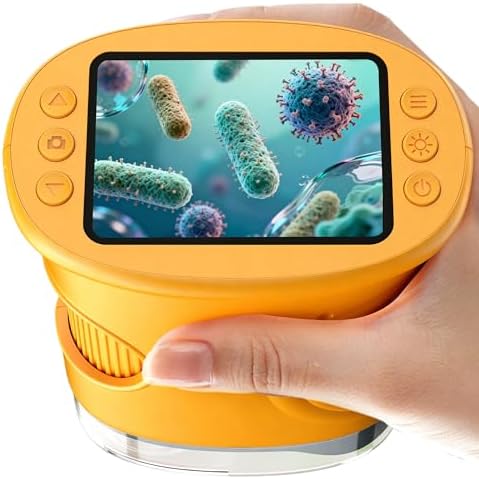
2. BMDSAE 1000X Handheld Digital Microscope — Best Digital Option
- 【1000X Magnification & 2MP Camera】Real 1000X optical+digital magnification with manual focus control – seeing actual pla…
- 【ABS Plastic Material, CE/FCC/CPC Safety Certified】Kid-Friendly Design,Made from eco-friendly ABS plastic, with CE/FCC/C…
- 【Anti-Shake & 8 Adjustable LEDs & 600mAh battery】Our exclusive 8-LED system with 3 adjustable brightness modes (Off/Medi…
Key Specs
- Magnification: Up to 1000x (optical + digital)
- Screen: 2.0-inch built-in IPS display
- Battery: Rechargeable (USB-C), approximately 2.5 hours of continuous use
- Design: Handheld, portable — no desk or slide preparation required
- Price tier: Budget
Who this is for: Younger kids (ages 4–10) who will lose interest with a traditional microscope setup, outdoor explorers who want to examine things in the field, and families who want the most approachable entry point into microscopy.
Digital handheld microscopes can look like gimmicks at first glance: a tiny built-in screen, some plastic optics, and a novelty that might wear off in a day. Owner reviews on this one suggest otherwise.
The BMDSAE 1000X is popular for a reason: it removes all the friction. There’s no slide preparation. No figuring out which eyepiece to use. No USB cable tethering it to a power source. You just pick it up, point it at something, and look at the 2-inch IPS screen. Most 6-year-olds can operate it on their own almost straight out of the box.
The screen quality is a highlight in owner reviews. IPS panels have better color accuracy and wider viewing angles than the LCD screens on older models, and even at higher magnifications the image is clear enough to make out fine detail — wing scales on a butterfly, the texture of a coin’s surface, the weave pattern in a piece of denim. At lower magnifications like 50x–200x, the image is crisp and immediately engaging. Yes, at the upper end of the magnification range the image quality degrades a bit due to digital zoom limits, but kids don’t care — they’re just delighted by what they’re seeing.
The rechargeable battery is a big practical win over models that need AA batteries constantly replaced. About 2.5 hours of use on a full charge, which is typically more than enough for a session before kids find something else to do. The rubber casing adds meaningful drop protection — owners report it surviving falls off a desk without any damage.
The trade-off is that this is digital, not purely optical. Traditional compound microscopes give sharper images for detailed specimen study like seeing individual cells clearly. If that level of scientific rigor is the goal, this handheld won’t match the AmScope. But for the target age group — outdoor exploration, casual curiosity, and the pure joy of magnification — it absolutely delivers.
Highlights:
- Zero setup friction — kids can use it independently immediately, no adult help required
- Portable and rechargeable — take it outside, on hikes, to the park
- IPS screen is genuinely good quality, not the blurry LCD of cheaper alternatives
- Rubber casing survives the drop abuse that younger kids will inevitably deliver
What could be better:
- Digital zoom loses clarity at the upper magnification range — not ideal for serious scientific work
- 2-inch screen is small; some kids find it slightly uncomfortable for extended sessions
Bottom line: The best first microscope for younger kids or families who want maximum approachability. As a budget pick, it’s a low-risk gift that delivers genuine delight. If your kid gets hooked, you can always upgrade to the AmScope later.
3. National Geographic Junior Microscope — Best Starter Kit for Ages 6–10

- KIDS WILL LOVE THIS MICROSCOPE – The focus dial and adjustable platform make it easy to keep specimens positioned just r…
- EXPLORE FREELY WITH DETACHABLE EYEPIECE – The eyepiece on this kid’s microscope easily detaches, allowing kids to explor…
- FASCINATING SPECIMENS – Kids get 6 prepared slides in this microscope kit, along with 6 blank slides to prepare at home!…
Key Specs
- Magnification: Up to 250x
- Illumination: LED (battery-powered)
- Kit contents: Microscope, 6 prepared slides, 6 blank slides, lab guide, bonus handheld mini scope
- Brand: National Geographic / Blue Marble
- Price tier: Budget
Who this is for: Kids aged 6–10 who are ready for their first traditional compound microscope — one that’s simple enough to use independently from day one, without the setup complexity of a full-featured scope.
The National Geographic Junior Microscope threads a needle that’s harder than it looks: it’s simple enough for a 6-year-old to use on their own, but produces real optical images using glass lenses — not a camera and screen like the BMDSAE. When a curious 7-year-old first looks at a prepared slide of plant cells and sees actual cell walls through the eyepiece, it’s a qualitatively different experience from scrolling through a digital display. That’s what this microscope is built to deliver.
What National Geographic does particularly well is the first-use experience. Parents say opening this kit feels like opening a science set, not a toy. The lab guide walks kids through their first observations with clear instructions and explains what they’re actually seeing — which is the kind of contextual learning that makes the difference between a kid who looks through a microscope once and one who asks to do it again. The bonus handheld mini scope is a standout addition: kids can take it outside to examine leaves, bark, and insects in the field, then bring specimens back to the desk scope for closer study.
The top magnification of 250x is lower than the AmScope’s 1200x ceiling, but for this age group it’s the right call. At 250x, slides are bright, easy to focus, and detailed enough to see plant cell structures and the texture of everyday objects up close. Kids in the 6–10 range rarely benefit from pushing past 250x — higher magnification means narrower depth of field and more frustration. The Junior hits the sweet spot where images are impressive and independent use is genuinely achievable.
Battery-powered illumination means no USB tethering — kids can carry it to different rooms or bring it out at the kitchen table without needing a power source nearby. The plastic body keeps weight low at 14 ounces, making it easy for smaller hands to handle, though it won’t absorb drops as well as the AmScope’s metal construction. A dedicated kid who gets seriously into microscopy will outgrow the 250x ceiling within a year or two, but as a first compound microscope for a curious 6–8 year old, it delivers the real optical experience without the complexity.
Highlights:
- 250x sweet spot — bright, easy-to-focus images without the frustration of over-magnification for young hands
- Battery-powered — fully portable, no desk tethering required
- Bonus handheld mini scope extends exploration beyond the desk into the field
- NatGeo lab guide teaches observation skills alongside the viewing experience
What could be better:
- 250x ceiling means kids who get seriously into microscopy will need an upgrade within a year or two
- Plastic body — lighter and portable but less durable under rough handling than metal-frame scopes
Bottom line: The best first traditional compound microscope for kids in the 6–10 range. Simple enough to use independently from day one, educational enough to keep them coming back, and portable enough to go wherever curiosity takes them. At a budget price, it’s a low-risk entry into real optical microscopy — and if they outgrow it quickly, you’ll know they’re ready for the AmScope.
How to Choose a Microscope for Kids: What Actually Matters
Magnification: Ignore the Big Numbers
Marketing on kids microscopes loves to lead with magnification numbers. “1200x!” “2000x!” It sounds impressive until you realize that higher magnification is only useful if the optical quality can support it. A cheap plastic lens at 1000x gives you a magnified blur. A quality glass lens at 400x shows you a crisp, detailed image.
For most kids, the genuinely useful range is 40x to 400x. At these magnifications, specimens are large enough to see clearly and images stay sharp. Cells in plant tissue, individual hair fibers, insects’ compound eyes — all clearly visible at 400x or below. If you want to see bacteria clearly, you need closer to 1000x, but that’s an advanced use case requiring proper slide preparation skills most kids develop over time. The practical rule: prioritize image clarity over maximum magnification.
Type of Microscope: Compound vs. Digital vs. Stereo
Compound microscopes (like the AmScope and National Geographic) use optical glass lenses and require specimens to be prepared on glass slides. They offer the sharpest images for biology specimens — cells, tissues, micro-organisms. These are the “real” microscopes kids see in science class. They require more setup but deliver the most genuine scientific experience.
Digital handheld microscopes (like the BMDSAE) use a camera sensor and built-in screen instead of optical eyepieces. No slide preparation required — you point them at anything and see a magnified image on the screen. Perfect for younger kids or outdoor exploration. Excellent image quality at lower magnification, but optical performance doesn’t match a proper compound microscope for biology work.
Stereo microscopes have lower magnification (typically 10x–40x) but let you view three-dimensional objects — coins, insects, rocks — without flattening them on a slide. Great for nature specimens but not for seeing cells. Less common in kids’ kits at this price range.
The honest answer: if your child is under 8, start with a digital handheld. Zero friction, immediate reward. If they’re 8–12 and genuinely curious about biology and science, the compound microscope is the right investment. If you’re not sure, the National Geographic Junior Microscope bridges the gap nicely.
Build Quality: What Actually Survives Kids
The single most important build quality feature is whether the body uses metal or plastic for the arm and base. A metal arm won’t flex when a kid grabs the microscope to move it. A metal base won’t warp if something heavy gets stacked on it. Owners of plastic-bodied microscopes commonly report a wobble developing at the focus column within 12–18 months of regular use, making fine focusing impossible.
Rubber grips and shock-absorbing casings matter for handheld models specifically. The BMDSAE’s rubber casing adds meaningful drop protection that cheaper models don’t have. The second thing to check is the focus mechanism — a coaxial focus knob (where you adjust coarse and fine focus using two concentric controls) is far better for kids than a single-knob system. It gives them more control and less frustration.
Related STEM Guides for Kids
- Best Telescope for Kids — from tiny things to the night sky
- Best Science Kits for Kids — experiments to pair with the scope
- Best Kids Camera — let them document what they find
Frequently Asked Questions
What magnification do you need to see cells?
For plant cells, which are larger, 100x–200x is typically sufficient — you can see cell walls clearly. For detailed cell structure or bacteria, you’ll need 400x–1000x with a quality compound microscope and properly prepared wet mount slides. Most kids’ compound microscopes in this price range handle plant cells excellently at 200x–400x.
What age is appropriate for a microscope?
Digital handheld microscopes work for ages 4 and up — there’s very little coordination required. Traditional compound microscopes are better suited to ages 8 and up, when kids have the fine motor control to prepare slides and adjust focus knobs precisely. The National Geographic Junior Microscope is calibrated for around 6–10 as a transition point.
Is a compound microscope or digital microscope better for kids?
Depends on the child’s age and interest. Digital handheld models offer immediate gratification with zero setup — perfect for younger kids or casual exploration. Compound microscopes provide a more authentic science experience and sharper images for biology specimens, but require more patience and coordination. If you’re buying for a kid under 8, start with digital. For older, more curious kids, go compound.
Can kids see bacteria with a kids microscope?
With a quality compound microscope at 400x–1000x, yes — bacteria are visible as tiny dots or rods, though you won’t see the detail you’d see in a lab-grade instrument. The AmScope at 600x–1200x can show yogurt bacteria on a properly prepared slide. Handheld digital microscopes don’t have the optical quality to reliably show bacteria at useful detail.
What can kids look at with a microscope?
More than you’d expect. Hair from their own head, pet fur, fabric fibers, flower pollen, feathers, insect wings, salt and sugar crystals, soil, pond water, onion skin, apple cells, cork cells, yogurt for bacteria, cheek cells — countless everyday objects become fascinating at 100x–400x. The best microscope kits include prepared slides so kids get immediate success before they start preparing their own specimens.
Are cheap microscopes under $20 worth buying?
Generally, no. At the sub-$20 price point, you’re getting all-plastic optics that produce blurry images at any magnification above 40x. Kids quickly realize the images don’t look like what they see in books or online, and interest dies fast. Stepping up to a budget-tier kit with real glass optics or a quality digital sensor, like the three picks in this article, is the minimum for a genuinely satisfying experience.
Is a microscope a good gift for kids?
Yes, with one caveat: match the type to the child. A digital handheld is a safe gift for any curious 5–10 year old — immediate results, no setup required. A compound microscope is better given to a specific child you know has genuine interest in science, because it requires engagement and patience to use well. Either way, it’s one of those gifts that leads to real learning rather than passive entertainment.
How long do kids stay interested in microscopes?
This varies enormously. Some kids look through it twice and move on. Others are still using theirs years later. Going by parent reviews, the kids who stay engaged longest are the ones whose microscopes have good optical quality (so the images are actually impressive) and a large accessory kit (so there’s always something new to look at). The AmScope’s 52-piece kit does well here — there’s enough variety to sustain interest for several months of regular exploration at minimum.
What’s the difference between a compound and stereo microscope?
Compound microscopes use two sets of lenses to achieve high magnification (100x–1200x+) and view thin, transparent specimens on glass slides — biological material like cells, tissues, and microorganisms. Stereo microscopes use lower magnification (10x–40x) and allow you to view three-dimensional, opaque objects — coins, insects, rocks — without slide preparation. For kids interested in biology, go compound. For kids interested in nature collecting and rocks, a stereo or digital handheld works well.
Do kids microscopes work for adults too?
The AmScope M30 absolutely does — it’s a genuine compound microscope that would be at home in a school lab. The optical quality is real. If you’re an adult looking for a beginner microscope, this is a legitimate option that happens to be marketed to kids. The National Geographic Junior Microscope and BMDSAE handheld are more child-oriented in their ergonomics, but adults can certainly use them.
Final Verdict
The best microscope for kids depends almost entirely on age and how seriously you expect the interest to develop. For children 8 and up who are genuinely curious about science, the AmScope M30-ABS-KT2-W is the clear winner — it’s a real compound microscope with metal construction, six magnification levels, and a 52-piece kit that delivers authentic science experiences at a very fair price. It’ll last through high school if treated reasonably well.
For younger kids or anyone who wants zero friction and maximum portability, the BMDSAE 1000X Handheld is the right call. As a budget pick it’s the most accessible entry point, and its strong owner reviews suggest real families keep recommending it. The IPS screen quality is genuinely good for this price category.
The National Geographic Junior Microscope is the starter kit — a simple, portable compound microscope for the 6–10 age range that gets kids into real optical viewing without the setup friction. As a budget pick, it’s a low-risk way to find out whether your child is ready for the AmScope experience.
Our recommendation for most families: buy the BMDSAE first if your child is under 8. If they’re still asking to look through it after three months, upgrade to the AmScope. You’ll know pretty quickly whether you have a future microbiologist on your hands.
- Explore Microscopy: The AmScope M30 Series 52-Piece STEM Microscope Kit for Kids is a complete set that introduces the f…
- Magnification: Equipped with six magnification settings from 120X to 1200X, this compound microscope enables young scien…
- User-Friendly Design: This portable microscope features a monocular viewing head with LED lighting and a rotating color …
- KIDS WILL LOVE THIS MICROSCOPE – The focus dial and adjustable platform make it easy to keep specimens positioned just r…
- EXPLORE FREELY WITH DETACHABLE EYEPIECE – The eyepiece on this kid’s microscope easily detaches, allowing kids to explor…
- FASCINATING SPECIMENS – Kids get 6 prepared slides in this microscope kit, along with 6 blank slides to prepare at home!…
- 【1000X Magnification & 2MP Camera】Real 1000X optical+digital magnification with manual focus control – seeing actual pla…
- 【ABS Plastic Material, CE/FCC/CPC Safety Certified】Kid-Friendly Design,Made from eco-friendly ABS plastic, with CE/FCC/C…
- 【Anti-Shake & 8 Adjustable LEDs & 600mAh battery】Our exclusive 8-LED system with 3 adjustable brightness modes (Off/Medi…
See full specs and accessory details on AmScope’s official product page.
Looking for more STEM gear? Check out our picks for the best science kits for kids under $50 and the best electronics kits for kids — both pair well with a microscope for a complete science setup at home.
Last updated: July 2026 | Prices subject to change.
Questions about any of these picks? Get in touch via our contact page.