
This post contains affiliate links. As an Amazon Associate, I earn from qualifying purchases at no extra cost to you.
Plenty of kids ask for “a real camera, not the one on the tablet,” and finding the best kids camera that won’t die the first time it hits the driveway is harder than it sounds. Turns out there’s a huge gap between the flimsy plastic toys that take blurry potato photos and the genuinely fun little cameras kids actually keep using months later. We compared a stack of them based on specs, verified owner reviews and manufacturer data — drop durability, ease of use for little hands, and real-world photo quality — and four rose to the top.
If you just want the short version: the VTech KidiZoom Camera Pix Plus is the best kids camera for most families because it’s tough, simple, and does a little of everything. But the right pick really depends on your kid’s age and whether they want to print their photos. Below I break down all four, what actually matters when you’re choosing, and answer the questions parents ask most.
My Top Pick — VTech KidiZoom Camera Pix Plus
It’s the one I’d hand to almost any kid between 3 and 9. The VTech feels built for abuse, the interface is dead simple, and the dual front-and-rear lenses mean selfies and “look what I found” shots both work without an adult stepping in. It’s not the sharpest camera here, but owners say it’s the one that keeps getting picked up.

- 2.0 megapixel digital camera with 4X zoom, 1.8” screen and four games; create a Talking Photo using your own photo, voic…
- Experiment with 40+ camera effects like photo frames, stamps, kaleidoscope effects, collages, video themes and more
- Stitch together 2–5 images to make a panoramic photo; create animations with up to 100 photos
Best Kids Camera — Quick Comparison


Here’s how the four stack up at a glance. Kids camera prices bounce around a lot around the holidays, so check the live price on Amazon before you buy.
Reviews — Detailed Breakdown
1. VTech KidiZoom Camera Pix Plus — Best Overall
- 2.0 megapixel digital camera with 4X zoom, 1.8” screen and four games; create a Talking Photo using your own photo, voic…
- Experiment with 40+ camera effects like photo frames, stamps, kaleidoscope effects, collages, video themes and more
- Stitch together 2–5 images to make a panoramic photo; create animations with up to 100 photos
Key Specs
- Cameras: dual (front selfie + rear), 2MP with 4x digital zoom
- Screen: 1.8″ color LCD
- Features: panoramic photos, talking photos, voice changer, 40+ effects, 5 built-in games
- Power: 4 AA batteries
- Storage: microSD up to 32GB (not included)
- Age range: 3–9
Who this is for: Parents who want one camera that just works for a preschooler or early-elementary kid without any fuss.
The Pix Plus is reassuringly chunky. It’s wrapped in that soft rubberized shell VTech uses on all its kid gear, with two big grippy handles on the sides that a small pair of hands actually wraps around. Parents consistently report it passing the test that matters most — sliding off a kitchen counter onto tile — and simply bouncing, shrugging, and working. That build is most of what you’re paying for.
The interface is where it wins. Parents say kids are taking photos within about a minute, no tutorial needed. Big directional pad, one obvious shutter button on top, chunky menu icons. The dual lenses are genuinely useful: kids can flip between filming the dog and filming their own face mid-sentence without ever handing it back to an adult. The talking-photo feature — where you snap a picture and record a little voice clip that plays back with a goofy filter — gets a lot of repeat use, according to parents. It’s the kind of gimmick that sounds pointless until you picture a six-year-old cackling at it for twenty minutes.
Photo quality is fine, not great, and that’s the honest trade-off. At 2 megapixels these are small, soft images — perfect for the camera’s own screen and for printing wallet-size, less so if you were hoping to frame an 8×10. In good daylight they’re cheerful and usable; indoors they get grainy fast. But here’s the thing: a kid this age isn’t chasing image quality, they’re chasing the act of taking pictures, and on that the VTech delivers all day.
My one real complaint is the AA batteries. It eats four of them, they’re not rechargeable out of the box, and if your kid leaves it switched on in a backpack you’ll be swapping cells constantly. Buy a set of rechargeable AAs and a charger at the same time — it’s the fix everyone eventually lands on.
What stands out:
- Survives real-world drops thanks to the rubberized, double-grip body
- So simple a three-year-old gets it in under a minute
- Dual lenses make selfies and video actually work for little kids
What could be better:
- Runs on 4 AA batteries — budget for rechargeables
- 2MP photos are soft indoors and in low light
Bottom line: The most well-rounded, kid-proof pick here. If you’re not sure which to get, get this one.
2. Seckton Upgrade Kids Selfie Camera — Best Budget
- CLEARER MOMENT RECORDED & MULTI-SCENE SELECTIONS: Equipped with auto Focus, 8.0 Mega pixels and 1080P Video. Greatly imp…
- UPGRADED DESIGN: Upgraded to dual-camera configuration, Easy to take selfies. Just open the switch key to enjoy the fun …
- POWERFUL BATTERY LIFE: Continuously taking photos for 1-2 hours after full charged! Come with 1 x USB data line & 1 x SD…
Key Specs
- Cameras: dual lens (front + rear), 1080p HD video
- Screen: 2.0″ IPS display
- Features: 16x zoom, filters, frames, puzzle games, built-in rechargeable battery
- Storage: 32GB microSD card included
- Extras: silicone shockproof sleeve + lanyard in the box
- Age range: 3–9
Who this is for: First-time buyers who want to spend the least while still getting a camera that records video and comes ready to use.
At its budget price the Seckton punches above its weight, and the reason is what’s in the box. Unlike the VTech, it ships with a 32GB card already included, a soft silicone sleeve, and a lanyard — so it’s genuinely ready to go the moment the wrapping paper comes off. No “oh, we need a memory card” delay on a birthday morning, which matters more than it sounds.
It’s tiny and feather-light — on paper it’s around a third of the weight of the VTech — which cuts both ways. A small kid can carry it on the lanyard all day and never get tired, but it also feels more plasticky, and the silicone bumper is doing a lot of the protective work. Owners report it surviving drops with the sleeve on. I wouldn’t push my luck without it.
The built-in rechargeable battery is the headline upgrade over the VTech. You top it up over USB like a phone and skip the AA treadmill entirely. Video is a legitimately nice surprise at this price — real 1080p that looks fine on the little IPS screen and acceptable on a laptop. The 16x “zoom” is digital and mushy, so ignore that number, but the base image in daylight is on par with cameras costing more.
Where it shows its price is the software. Menus are a little clunky and the on-board games are more basic than VTech’s. The translated interface has a couple of awkward labels. None of it stops a kid from having fun, but if you’ve handled a VTech you’ll feel the polish gap.
What stands out:
- Comes with a 32GB card, silicone case, and lanyard — ready on day one
- Built-in rechargeable battery, no AAs to buy
- Surprisingly decent 1080p video for the money
What could be better:
- Lightweight plastic body leans on the silicone sleeve for protection
- Clunky menus and basic mini-games versus the VTech
Bottom line: The best cheap kids camera to start with — especially if you’re buying for a kid who might lose interest, since you’re risking the least money.
3. VTech KidiZoom PrintCam — Best Instant Print
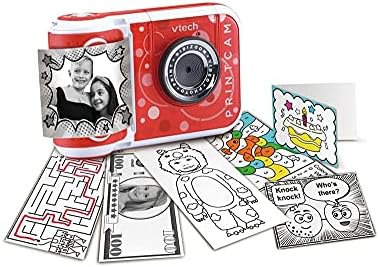
- KIDIZOOM PRINTCAM: Get ready to be creative with VTech’s KidiZoom PrintCam which includes a built-in thermal printer so …
- GET CREATIVE: This digital instant camera for kids includes photo effects, stamps and borders, 3 games, panoramic prints…
- FUN EDITS: You can also turn your photos into line drawings to colour or use the print shop to print games, design and p…
Key Specs
- Cameras: HD photo + video, flip-out selfie lens
- Printer: built-in thermal printer, ink-free (black & white)
- Features: 150+ effects, stamps and borders, comic-strip maker, panoramic prints, 3 games
- Power: built-in rechargeable battery
- Storage: microSD supported
- Age range: 5+
Who this is for: Kids who love the magic of watching a photo print out in their hands, and parents who don’t mind the ongoing paper cost.
This is the one that makes kids gasp. Point, shoot, and a few seconds later a little black-and-white photo scrolls out of the top like a tiny receipt. It uses ink-free thermal paper — the same tech as a cash register — so there are no cartridges to buy, just refill rolls. Parents describe kids papering their bedroom walls with prints of the cat, and owner reviews suggest it’s the most engaging camera of the four.
The flip-out selfie lens is a smart touch, and the built-in editing is genuinely deep: stamps, comic-strip layouts, borders, and enough silly effects to keep a creative kid busy for an afternoon. It’s rechargeable, described by owners as reasonably solid, and the digital photos it saves to the card are sharper than the two toy-grade cameras above.
Now the honest part. The prints are black-and-white only, and thermal prints fade over months — this is a novelty toy printer, not a keepsake machine. You’ll also keep buying refill paper, so factor that in as a running cost the way you would with a label maker. And it costs more than double the top pick. It earns that price only if the printing is the whole point for your kid; if it’s not, you’re paying for a feature they’ll use twice.
If your kid is leaning toward real photography rather than novelty printing, a proper starter setup like a beginner tripod paired with a simple camera makes more sense than a print gimmick.
What stands out:
- Instant thermal prints are pure magic for kids — genuinely engaging
- Ink-free paper, flip-out selfie lens, deep built-in editing
- Sharper digital photos than the cheaper toy cameras
What could be better:
- Prints are black-and-white only and fade over time
- Ongoing cost of refill paper, and it’s the priciest pick here
Bottom line: Worth it if the printing is the reason you’re buying. If not, save your money and get the Pix Plus.
4. Seckton 48MP Instant Print Camera — Best for Older Kids
- UPGRADED DUAL-LENS: Seckton kids instant print camera features front & rear cameras. Kids can easily take selfies or cap…
- MULIT-FUNTION KIDS CAMERA: The kids print camera is equipped with 16X Zoom, 48MP pixels and 1080P video. Greatly improve…
- BLACK AND WHITE THERMAL PRINTING: The kids camera adopts inkless thermal printing technology, more suitable for children…
Key Specs
- Cameras: dual lens, 48MP stills, 1080p video, 16x zoom
- Screen: 2.4″ display
- Printer: built-in ink-free thermal printer
- Power: built-in rechargeable battery
- Storage: 32GB microSD card included
- Age range: 3–12
Who this is for: Older kids and tweens who want higher-resolution photos and the print feature, without paying VTech PrintCam money.
This is the value play, and it’s a clever one. You get the same instant-print party trick as the VTech PrintCam — thermal, ink-free, prints in seconds — but the camera side is aimed at an older kid who cares a bit more about how the photos actually look. The listed 48MP resolution is marketing-inflated (the real sensor is smaller), but owners report daylight photos that are noticeably crisper than the toy-grade cameras, and the larger 2.4″ screen makes composing shots easier for bigger hands.
It ships fully loaded: 32GB card, rechargeable battery, and the printer built in, all for a bit more than the budget Seckton and a fraction of the VTech PrintCam. For a nine-to-twelve-year-old who’s outgrowing “toy” branding but isn’t ready for a real mirrorless setup, it hits a nice middle ground. The print quality is the same faded black-and-white thermal as any of these — fun, not archival.
The downsides are the same Seckton software roughness as the budget model — occasionally clunky menus, a few odd translations — plus the printer adds bulk and the refill-paper cost. But for the price, getting sharper photos, a bigger screen, and printing in one device is hard to argue with. If your kid is genuinely getting into photography, it’s also a gentle on-ramp toward the kind of gear in our kids microscope and kids telescope guides, where the same “start simple, grow into it” logic applies.
What stands out:
- Crisper daylight photos and a bigger 2.4″ screen than the toy cameras
- Instant printing for a third of the VTech PrintCam’s price
- Comes complete with a 32GB card and rechargeable battery
What could be better:
- 48MP claim is inflated marketing — good, not DSLR-good
- Same clunky Seckton menus and thermal-paper running cost
Bottom line: The smart-money print camera for an older kid — most of the VTech PrintCam’s fun at a third of the price.
How to Choose the Best Kids Camera: What Actually Matters
Match the camera to your kid’s age
This is the single biggest mistake buyers make. A camera built for a three-year-old will bore a ten-year-old within a day, and a feature-heavy camera aimed at tweens frustrates a toddler. For ages 3–5, prioritize durability and dead-simple controls — the VTech Pix Plus or the budget Seckton. For 6–9, you can add features like printing and better video. For 10–12, lean toward higher resolution and a bigger screen, like the 48MP Seckton, because kids this age genuinely notice blurry photos and lose interest fast.
Durability beats megapixels
Every one of these cameras is going to be dropped, probably on day one. A rubberized body or an included silicone sleeve matters far more than a spec-sheet resolution number. Don’t get seduced by a big megapixel claim on a cheap kids camera — most of those numbers are inflated, and image quality on tiny toy sensors is limited no matter what the box says. Buy for the drop test, not the pixel count.
Batteries and what’s in the box
Check what’s in the box. The budget Seckton and the 48MP Seckton both include a 32GB card, which is a real convenience on a gift morning, while the VTech models need a card you supply. Three of the four run on built-in rechargeable batteries (a big quality-of-life upgrade over the VTech Pix Plus’s AA habit), and the two print cameras add instant printing on top. If you go with the AA-powered Pix Plus, buy a set of rechargeable AAs at the same time and thank yourself later.
Do you actually want printing?
Instant printing is the most divisive feature here. Some kids are mesmerized by it and paper the house in prints; others snap two and never touch it again. It also adds cost — both upfront and in refill paper — and the prints are black-and-white and fade over time. If you’re not sure, skip it and save the money; you can always add a print camera later if the interest is real.
Related STEM Guides for Kids
- Best Binoculars for Kids — another great outdoor gift
- Best Kids Smartwatch — no-subscription picks
- Best Walkie Talkies for Kids — screen-free adventure gear
Frequently Asked Questions
What is the best camera for a 7 year old?
For most seven-year-olds the VTech KidiZoom Camera Pix Plus is the sweet spot — it’s tough, simple, and has dual lenses for selfies and video. If your seven-year-old is more into crafts and novelty, a print camera like the Seckton 48MP is a fun alternative.
Are kids cameras worth it, or should I just use an old phone?
A dedicated kids camera is worth it for two reasons: it’s built to survive drops that would shatter a phone, and it has no internet, apps, or ads — so you’re handing a kid a camera, not a distraction machine. For young kids especially, that simplicity is the whole point.
How many megapixels does a kids camera need?
Fewer than the marketing suggests. Toy cameras use small sensors, so a real 2–5MP is plenty for on-screen viewing and small prints. Ignore inflated “48MP” claims — build quality, ease of use, and battery type matter far more than the pixel number.
What age is a kids camera good for?
Most are aimed at ages 3–12, but the right pick narrows that a lot. Simple, rugged models suit 3–6; feature-rich and print cameras suit 6–9; higher-resolution cameras with bigger screens suit 9–12.
Do these kids cameras record video?
Yes — all four here record video. The two Seckton models and the VTech PrintCam do 1080p HD, while the VTech Pix Plus records at a lower resolution. Video quality is fine for fun clips, not for polished home movies.
What’s the difference between the VTech PrintCam and the Seckton print camera?
Both print instantly on ink-free thermal paper. The VTech PrintCam has more polished software and brand-name reliability but costs noticeably more. The Seckton 48MP does the same printing with sharper photos and a bigger screen for about a third of the price, at the cost of rougher menus.
Do kids cameras need a memory card?
Most do. The budget Seckton and 48MP Seckton include a 32GB card in the box. The VTech models take a microSD card up to 32GB that you supply separately — grab one when you order.
Are the instant prints permanent?
No. Thermal prints are black-and-white and fade over months, especially in sunlight. Treat them as fun, disposable novelties rather than keepsakes — the digital photos saved to the memory card are what you’d actually keep.
Is a kids camera worth it in 2026?
Yes, if you match it to the child. A screen-free, drop-proof camera that gets a kid looking at the world instead of a tablet is an easy win — just don’t overspend on features like printing unless you know your kid will use them.
Final Verdict
After comparing all four, the VTech KidiZoom Camera Pix Plus is the best kids camera for most families — rugged, simple, and fun across the widest age range. If money’s tight or you’re just dipping a toe in, the Seckton Upgrade Kids Selfie Camera is the best budget pick and comes ready to shoot out of the box. Want the instant-print magic? The VTech KidiZoom PrintCam is the premium choice, while the Seckton 48MP gives older kids most of that fun for far less. Buy for your kid’s age and durability first, and you really can’t go wrong with any of these.
Please enter product(-s) ASIN(-s)!See full specs on the VTech KidiZoom Camera Pix Plus official page.
Last updated: August 2026 | Prices subject to change.
Questions about any of these picks? Get in touch via our contact page.