This post contains affiliate links. As an Amazon Associate, I earn from qualifying purchases at no extra cost to you.
The best digital piano for beginners is the one that still feels right a year from now — when you’ve moved past “Ode to Joy” and your fingers need real resistance to build control. That’s the trap with cheap keyboards: light, springy keys are easy on day one, but they teach habits that don’t transfer to a real piano, and many learners outgrow them within months.
The good news is that an 88-key digital piano with properly weighted, hammer-action keys costs far less than an acoustic piano, never needs tuning, has a headphone jack for silent practice at midnight, and connects to learning apps on your phone or tablet. We compared the beginner digital pianos with an active Amazon buy box and consistently positive owner feedback on key action, piano sound, speakers, connectivity, portability and what owners and teachers say matters for the first few years of lessons. Here are six picks, from a semi-weighted starter to a step-up model you won’t outgrow.
Quick Picks
- Best overall: Yamaha P-145 — Graded Hammer Compact action, a grand piano voice, Bluetooth audio and Yamaha’s Smart Pianist app support.
- Best key feel: Roland FP-10 — Roland’s acoustic-feel keyboard with ivory-feel keys, SuperNATURAL piano sound and USB/MIDI for apps and recording.
- Best value: Yamaha P71 (Amazon exclusive) — weighted action and a Yamaha grand piano voice, with a long owner track record and a sustain pedal included.
- Most portable: Casio Privia PX-S1100 — under 25 lb, runs on batteries, Bluetooth audio and MIDI adapter included.
- Best step-up: Yamaha P-225 — Yamaha’s CFX concert grand voice, 24 instrument voices and a richer sound for players who know they’re committed.
- Best budget pick: Alesis Recital — 88 full-size semi-weighted keys, 20W speakers and battery power at the lowest price tier.
My Top Pick — Yamaha P-145
For most adult beginners and parents buying for a child, the Yamaha P-145 is the safest choice. Its 88 weighted keys use Yamaha’s Graded Hammer Compact action, which is heavier in the low keys and lighter in the high keys like an acoustic piano. That’s the feel piano teachers want students practicing on. Add a grand piano sample, Bluetooth audio for playing along with songs, and app support for practice tools, and it covers everything a beginner needs without paying for features they won’t use yet.
Price as of Nov 2, 2026, 10:05 AM UTC. Product prices and availability are accurate as of the date/time indicated and are subject to change. Any price and availability information displayed on Amazon.com at the time of purchase will apply to the purchase of this product.
Best Digital Piano for Beginners — Quick Comparison


Price as of Oct 30, 2026, 8:25 AM UTC. Product prices and availability are accurate as of the date/time indicated and are subject to change. Any price and availability information displayed on Amazon.com at the time of purchase will apply to the purchase of this product.
| Digital Piano | Price Tier | Key Action | Bluetooth | Best For |
|---|---|---|---|---|
| Yamaha P-145 | Mid-range | Graded Hammer Compact (weighted) | Audio | Best overall |
| Roland FP-10 | Mid-range | Acoustic-feel weighted, ivory-feel keys | MIDI (app) | Most realistic feel |
| Yamaha P71 | Budget–Mid | Weighted action | No | Best value |
| Casio Privia PX-S1100 | Premium | Weighted, touch-responsive | Audio + MIDI (adapter included) | Portability |
| Yamaha P-225 | Premium | Graded weighted action | App connectivity | Step-up, best sound |
| Alesis Recital | Budget | Semi-weighted | No | Tightest budget |
Live prices appear in the product boxes and change often.
Digital Piano for Beginners Reviews — Detailed Breakdown
1. Yamaha P-145 — Best Overall
Price as of Nov 2, 2026, 10:05 AM UTC. Product prices and availability are accurate as of the date/time indicated and are subject to change. Any price and availability information displayed on Amazon.com at the time of purchase will apply to the purchase of this product.
Key Specs
- Keys: 88 weighted, touch-sensitive, Graded Hammer Compact (GHC) action
- Sound: Yamaha grand piano voice with natural resonance
- Connectivity: Bluetooth audio streaming; Smart Pianist and Rec’n’Share app support
- Design: slim, lightweight, portable
- Included: music rest, sustain foot switch, AC adapter
Who this is for: Adult beginners, teens and kids starting lessons who want a piano that feels right from the first lesson through the intermediate years.
Yamaha’s P-series has been the default recommendation from piano teachers for years, and the P-145 is the current entry point. The key reason is the action. “Graded” means the keys get progressively lighter as you move up the keyboard, exactly like the hammers inside an acoustic piano. That matters more than any feature list: finger strength and control built on a graded action carry straight over when a student plays a real piano at a lesson or recital.
The P-145 adds the modern conveniences that make practice easier. Bluetooth audio lets you stream songs from your phone through the piano’s speakers and play along — a surprisingly big motivator for beginners. Yamaha’s Smart Pianist app turns the phone into a control panel and practice tool, and Rec’n’Share helps you record and share performances, which is useful for remote lessons or for tracking progress over months.
It’s also compact and light enough to move between rooms or take to lessons. The trade-off is the speaker system, which is fine for a bedroom or living room but not as rich as the P-225’s. And like most portable digital pianos, the included foot switch is a small square pedal; many players eventually upgrade to a piano-style sustain pedal.
Why we picked it:
- Graded Hammer Compact action — the feel teachers recommend
- Bluetooth audio for playing along with songs
- Smart Pianist and Rec’n’Share app support
- Slim, light and easy to move
What could be better:
- Speakers are adequate rather than rich
- Basic square foot switch included
- Sold by a third-party retailer on this listing
Bottom line: The best digital piano for beginners for most households — authentic feel, useful connectivity, no unnecessary extras.
2. Roland FP-10 — Best Key Feel
Price as of Nov 2, 2026, 10:05 AM UTC. Product prices and availability are accurate as of the date/time indicated and are subject to change. Any price and availability information displayed on Amazon.com at the time of purchase will apply to the purchase of this product.
Key Specs
- Keys: 88-note acoustic-feel weighted keyboard with ivory-feel key surface
- Sound: SuperNATURAL Piano sound engine
- Connectivity: USB/MIDI interface; Roland Piano App control
- Practice: quiet key action and headphone output; Twin Piano mode for lessons
- Included: DP-2 foot switch, music rest; matching KSCFP10 stand sold separately
Who this is for: Beginners who care most about how the keys feel, and anyone who plans to connect the piano to a computer for lessons, recording or GarageBand.
Ask pianists who’ve played both and many will tell you the Roland FP-10 has one of the most convincing key actions at its price. The ivory-feel keys have a slightly textured surface that absorbs a little moisture and keeps fingers from slipping — a detail you notice during long practice sessions. Combined with weighted, acoustic-style resistance, it feels closer to a real piano than most entry-level instruments.
Roland’s SuperNATURAL piano engine responds well to dynamics: play softly and you get a gentle, rounded tone; dig in and it brightens. For beginners learning to control volume with their fingers, that responsiveness is a teaching tool. The quiet key mechanism is another plus for shared homes — combined with headphones, late-night practice won’t wake anyone.
Twin Piano mode splits the keyboard into two identical ranges, so a teacher and student can sit side by side and play the same notes — great for home lessons. The built-in USB/MIDI interface connects to laptops and DAW software, and the Roland Piano App gives you an easy way to change sounds and set the metronome. The FP-10’s speakers are modest, and it lacks Bluetooth audio streaming, so you can’t play along with phone music through the piano itself.
Why we picked it:
- Very realistic weighted action with ivory-feel keys
- Expressive SuperNATURAL piano sound
- Twin Piano mode for lessons; quiet keys for silent practice
- USB/MIDI for apps, GarageBand and recording
What could be better:
- No Bluetooth audio streaming
- Modest built-in speakers
- Stand sold separately
Bottom line: The best beginner digital piano if key feel is your top priority.
3. Yamaha P71 (Amazon Exclusive) — Best Value
Price as of Nov 2, 2026, 12:09 PM UTC. Product prices and availability are accurate as of the date/time indicated and are subject to change. Any price and availability information displayed on Amazon.com at the time of purchase will apply to the purchase of this product.
Key Specs
- Keys: 88 weighted, touch-sensitive keys
- Sound: 10 voices including a Yamaha grand piano
- Dual Mode: layer two voices (e.g. piano + strings)
- Controls: simple one-button operation
- Included: sustain pedal and power supply
Who this is for: Families who want a proven, no-fuss weighted Yamaha for a child’s first lessons at the lowest Yamaha price tier.
The P71 is an Amazon-exclusive version of Yamaha’s long-running entry-level P-series piano, and its long track record with owners tells the story. You get 88 weighted keys and a Yamaha grand piano voice — the essentials — in a simple design with one-button operation. For a 7-year-old starting lessons, fewer menus can actually be a good thing.
Ten voices and Dual Mode give some variety for fun, letting you layer piano with strings for fuller-sounding pieces. It’s sold and shipped by Amazon, which simplifies returns, and it includes a sustain pedal and power supply so you only need a stand and bench to get started.
What you give up compared with the P-145 is the modern connectivity: no Bluetooth audio and fewer app-based practice tools. It’s also an older design. But for a beginner whose priority is weighted keys and a trusted brand at the best price, the P71 remains one of the most recommended buys on Amazon.
Why we picked it:
- Weighted Yamaha action at a lower price tier
- Huge, long-standing owner base
- Simple controls, sustain pedal included
- Sold and shipped by Amazon
What could be better:
- No Bluetooth or app-based learning features
- Older design and basic speakers
- Fewer voices than step-up models
Bottom line: The best value digital piano for beginners who want weighted Yamaha keys without extra features.
4. Casio Privia PX-S1100 — Most Portable
Price as of Oct 30, 2026, 8:25 AM UTC. Product prices and availability are accurate as of the date/time indicated and are subject to change. Any price and availability information displayed on Amazon.com at the time of purchase will apply to the purchase of this product.
Key Specs
- Keys: 88 weighted, touch-responsive
- Sound: German grand piano tone with string and damper resonance, plus 17 other tones
- Portability: 43% smaller than previous Privia models, under 25 lb, runs on batteries
- Connectivity: WU-BT10 Bluetooth audio and MIDI adapter included; USB-MIDI
- Learning: Casio Music Space app, built-in MIDI/audio recorder, Duet Mode
Who this is for: Apartment dwellers, college students, and anyone who wants a full 88-key piano they can move to a desk, table or even the couch.
The PX-S1100 is remarkably slim for a weighted 88-key piano. Casio says it’s 43% smaller than previous Privia models and it weighs under 25 lb, so you can store it under a bed or behind a sofa and set it on a table when it’s time to practice. It also runs on batteries — rare in this category — which makes it practical for small spaces without a nearby outlet or for taking to a friend’s place.
Connectivity is generous. Casio includes the WU-BT10 adapter for both Bluetooth audio and Bluetooth MIDI, so you can stream backing tracks through the speakers and connect wirelessly to learning apps. The Casio Music Space app, a built-in recorder and Duet Mode for teacher-student play round out a strong learning toolkit.
The design is glossy and modern with illuminated touch controls. The trade-off is that touch panels and a glossy finish show fingerprints, and some pianists prefer the feel of the Yamaha or Roland actions. It’s also one of the pricier picks here, so it makes most sense if portability and connectivity are what you need.
Why we picked it:
- Under 25 lb and battery-powered — the most portable weighted piano here
- Bluetooth audio + MIDI adapter included
- Casio Music Space app, recorder and Duet Mode
- Stylish slim design for small rooms
What could be better:
- Glossy finish and touch panel show fingerprints
- Premium price tier for a beginner instrument
- Some players prefer Yamaha or Roland key feel
Bottom line: The best digital piano for beginners who need to move or store it easily.
5. Yamaha P-225 — Best Step-Up
Price as of Nov 2, 2026, 10:05 AM UTC. Product prices and availability are accurate as of the date/time indicated and are subject to change. Any price and availability information displayed on Amazon.com at the time of purchase will apply to the purchase of this product.
Key Specs
- Keys: 88 weighted, heavier in the low keys and lighter in the high keys
- Sound: Yamaha CFX Full Concert Grand voice
- Voices: 24 instrument voices (pianos, organs, strings, bass)
- Connectivity: Smart Pianist and Rec’n’Share app support
- Included: music rest, sustain foot switch, power adapter
Who this is for: Committed adult learners and families who’d rather buy once than upgrade in two years.
If you already know you’ll stick with piano, the P-225 is worth considering over the P-145. Its biggest advantage is sound: Yamaha’s CFX voice is sampled from its flagship full concert grand, with natural resonance that makes chords and pedaled passages sound fuller. Better speakers make that difference audible without headphones, which matters when you play for family.
The graded weighted action keeps the same teaching benefit as the P-145, and 24 voices give more variety for pop, worship music or jazz. App support with Smart Pianist and Rec’n’Share adds practice and recording tools.
The downside is simple: it costs more, and a complete beginner may not hear the difference in the first months. If budget is tight, start with the P-145 or P71. If you want an instrument you’ll keep through intermediate level, the P-225 is the better long-term buy.
Why we picked it:
- Yamaha CFX concert grand voice — the best sound here
- Graded action that carries over to acoustic pianos
- 24 voices and app connectivity
What could be better:
- Premium price tier
- Low stock on this listing at the time of writing
- Extra features may be overkill for the first year
Bottom line: The best digital piano for beginners who want to buy once and grow into it.
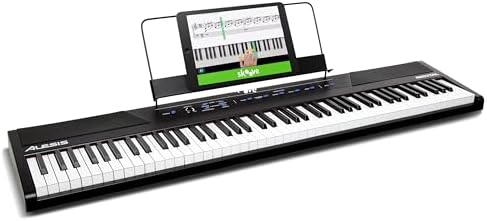
6. Alesis Recital — Best Budget Pick
Price as of Nov 2, 2026, 12:09 PM UTC. Product prices and availability are accurate as of the date/time indicated and are subject to change. Any price and availability information displayed on Amazon.com at the time of purchase will apply to the purchase of this product.
Key Specs
- Keys: 88 full-size semi-weighted keys with adjustable touch response
- Sound: 5 voices (acoustic piano, electric piano, organ, synth, bass), chorus and reverb
- Speakers: two built-in 20W speakers
- Power: AC adapter or 6 D-cell batteries
- Learning: lesson, split and layer modes; trial lesson subscriptions included
Who this is for: Families on a tight budget, or anyone checking whether piano will stick before investing in fully weighted keys.
The Alesis Recital is one of the most popular budget 88-key keyboards on Amazon, with a large base of satisfied owners. The key thing to understand is that its keys are semi-weighted, not hammer-action. They have more resistance than a cheap keyboard but less than the Yamaha or Roland, and the weight isn’t graded across the range.
For a curious beginner, that’s a reasonable compromise: you still get all 88 full-size keys, so you can learn proper hand positions and full-range pieces, plus 20W speakers that fill a room better than many budget keyboards. Lesson mode splits the keyboard into two identical zones for teacher and student, and it runs on D-cell batteries if you need it to. It’s sold and shipped by Amazon.
Note that a sustain pedal isn’t included — budget for one. And if lessons become serious, plan to upgrade to a fully weighted, graded action within a year or two, because finger strength built on semi-weighted keys doesn’t transfer as well.
Why we picked it:
- Lowest price tier with 88 full-size keys
- Two 20W speakers; battery power option
- Lesson mode and trial lesson subscriptions
- Sold and shipped by Amazon
What could be better:
- Semi-weighted, not hammer-action
- No sustain pedal included
- Likely to be outgrown by serious students
Bottom line: The best budget option for trying piano out — just know it’s semi-weighted.
How to Choose a Digital Piano for Beginners: What Actually Matters
Key Action: Weighted, Graded or Semi-Weighted
This is the most important decision. Weighted hammer-action keys mimic the resistance of an acoustic piano’s hammers. Graded actions go a step further: heavier in the bass, lighter in the treble. Semi-weighted keys have some resistance but no hammer mechanism. If you’re taking lessons, choose fully weighted (ideally graded). Semi-weighted is acceptable only for casual playing or a very tight budget.
88 Keys vs 61 Keys
Every pick here has 88 keys, the full range of an acoustic piano. A 61-key keyboard is cheaper and smaller but runs out of range for many classical and intermediate pieces within a year or two. For lessons, 88 keys is the standard.
Sound and Speakers
All the major brands sample real grand pianos; the differences are in resonance and the quality of the speakers. Beginners practicing on headphones won’t notice speaker quality much. If you’ll play aloud in a living room, step-up models like the Yamaha P-225 sound fuller. A good pair of headphones also makes silent practice more pleasant — see our picks for the best headphones for studying, which also suit late-night practice.
Connectivity and Learning Apps
Bluetooth audio lets you play along with songs through the piano. Bluetooth MIDI or USB-MIDI connects to learning apps (Simply Piano, Flowkey, Skoove), GarageBand and notation software. If your child takes online lessons, look for USB or Bluetooth MIDI. To record videos of practice for a teacher, a clip-on lavalier microphone for iPhone or a USB microphone captures much clearer audio than a phone’s built-in mic.
Accessories You’ll Need
Plan for a stand (X-stand or matching furniture stand), an adjustable bench, a piano-style sustain pedal (better than the small square switches included with most portables) and headphones. A furniture-style stand makes a portable piano look and feel more like a home piano, and a proper bench height helps posture.
Frequently Asked Questions
What is the best digital piano for a beginner?
For most beginners, the Yamaha P-145 is the best all-around choice thanks to its graded weighted action, grand piano sound and Bluetooth audio. If key feel is your top priority, the Roland FP-10 is a strong alternative.
Should a beginner get weighted keys?
Yes, if you’re taking lessons or plan to play an acoustic piano. Weighted keys build finger strength and control that transfer to a real piano. Unweighted or light keys can lead to habits that are harder to correct later.
Is a digital piano good for learning?
Yes. Modern digital pianos with 88 weighted keys are excellent for learning, and they add useful tools: headphone practice, metronomes, recording and app connectivity. They also never need tuning.
Do I need 88 keys as a beginner?
It’s recommended. Many beginner pieces fit on 61 keys, but intermediate repertoire quickly needs the full 88-key range. Buying 88 keys from the start avoids an early upgrade.
What is the difference between a digital piano and a keyboard?
Digital pianos focus on replicating an acoustic piano with 88 weighted keys and realistic piano sound. Keyboards usually have fewer, lighter keys and many more sounds and rhythms. For lessons, a digital piano is the better tool.
Is Yamaha or Roland better for beginners?
Both are excellent. Yamaha’s graded actions and simple controls are a teacher favorite; Roland’s FP-10 often wins on key feel and expressive sound. Try to compare in a store if you can, but either is a solid choice.
Can you learn piano on a semi-weighted keyboard?
You can start, but it’s not ideal for long-term progress. Semi-weighted keys like the Alesis Recital’s are fine for exploring, but serious students should move to a fully weighted action within a year or two.
How much should I spend on a beginner digital piano?
Budget options with semi-weighted keys are the cheapest, but a fully weighted 88-key piano from Yamaha, Roland or Casio is the sweet spot for lessons. Step-up models add better sound and features for committed learners.
Do digital pianos need a stand?
Portable digital pianos don’t include a stand, so you’ll need an X-stand, a table at the right height or a matching furniture stand. The right height matters for posture and hand position.
Can I use headphones with a digital piano?
Yes. Every pick here has a headphone output for silent practice. Bluetooth headphones add audio delay and many digital pianos don’t support them, so wired headphones are the safest choice for low latency.
Final Verdict
The Yamaha P-145 is the best digital piano for beginners for most people, with a graded hammer action, grand piano sound and Bluetooth audio. Choose the Roland FP-10 for the most realistic key feel, the Yamaha P71 for the best value from a trusted brand, the Casio Privia PX-S1100 if portability matters, and the Yamaha P-225 if you want to buy once and grow into it. On a tight budget, the Alesis Recital gets you 88 keys — just remember it’s semi-weighted.
Price as of Oct 30, 2026, 8:25 AM UTC. Product prices and availability are accurate as of the date/time indicated and are subject to change. Any price and availability information displayed on Amazon.com at the time of purchase will apply to the purchase of this product.
See full specs on Yamaha’s official site.
Questions about any of these picks? Get in touch via our contact page.