This post contains affiliate links. As an Amazon Associate, I earn from qualifying purchases at no extra cost to you.
The best quiet window air conditioner is the one you forget is running at 2 a.m. — no compressor clunking on and off, no rattle in the sash, no drone you have to drown out with a fan. That used to mean paying for a mini-split. It doesn’t anymore. Inverter window units, and especially the U-shaped designs that let the window close through the unit, now run in the low-30s to mid-40s decibel range on paper — quiet enough for a bedroom.
The problem is that “quiet” is printed on almost every window AC box, including plenty that run at 54–55 dB on their lowest setting. That’s a big difference you can actually hear. We compared the window air conditioners with an active Amazon buy box and consistently positive owner feedback, on rated noise level, compressor type, cooling area, window fit and what owners say about sleeping next to them. Here are five picks: three inverter models for people who want real silence, and two budget conventional units that are the quietest of their type.
Quick Picks
- Best overall: Midea U 10,000 BTU Smart Inverter (U-shaped) — rated as low as 32 dBA, ENERGY STAR, Wi-Fi and voice control, and your window still opens.
- Best for small bedrooms: Midea U 6,000 BTU Smart Inverter — the same U-shaped, 32 dBA design sized for rooms up to 250 sq ft.
- Best traditional-shape inverter: LG 10,000 BTU Dual Inverter — 44 dB in sleep mode, ThinQ app, and a conventional box shape if a U-unit won’t fit your window.
- Best budget pick: LG 8,000 BTU (LW8024RD) — a non-inverter unit rated at 53 dB on low, with auto restart after power cuts.
- Best compact budget pick: Frigidaire 8,000 BTU — 54 dBA, sleep mode, dry mode and the narrowest body here at 15.8″ wide.
My Top Pick — Midea U 10,000 BTU Smart Inverter
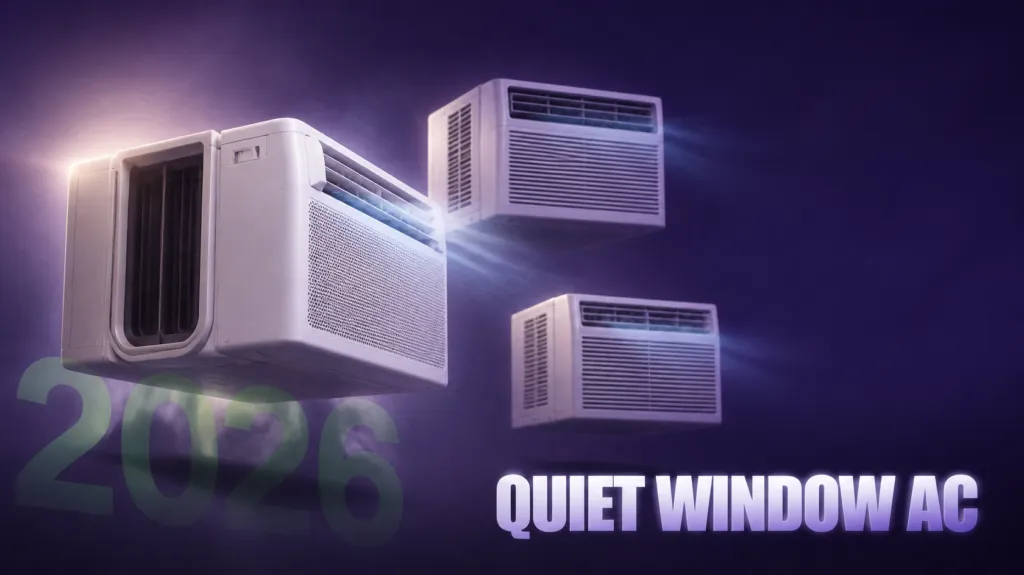
If noise is the reason you’re shopping, the Midea U is the one to beat. Its U-shaped body sits on both sides of the window sash, so the window closes into the “U” and the glass itself blocks much of the compressor noise from the outside half. Add a DC inverter compressor that ramps speed up and down instead of cycling hard on and off, and you get the lowest rated noise in this guide — Midea quotes as low as 32 dBA — plus ENERGY STAR efficiency and app control.
Price as of Nov 25, 2026, 9:05 PM UTC. Product prices and availability are accurate as of the date/time indicated and are subject to change. Any price and availability information displayed on Amazon.com at the time of purchase will apply to the purchase of this product.
Best Quiet Window Air Conditioner — Quick Comparison


Price as of Nov 25, 2026, 9:05 PM UTC. Product prices and availability are accurate as of the date/time indicated and are subject to change. Any price and availability information displayed on Amazon.com at the time of purchase will apply to the purchase of this product.
| Product | Price Tier | Lowest Rated Noise | Compressor | Cools Up To |
|---|---|---|---|---|
| Midea U 10,000 BTU | Mid-range | 32 dBA | DC inverter | 450 sq ft |
| Midea U 6,000 BTU | Mid-range | 32 dBA | DC inverter | 250 sq ft |
| LG 10,000 BTU Dual Inverter | Premium | 44 dB (sleep) | Dual inverter | 450 sq ft |
| LG 8,000 BTU (LW8024RD) | Budget | 53 dB (low) | Conventional | 350 sq ft |
| Frigidaire 8,000 BTU | Budget | 54 dBA | Conventional | 350 sq ft |
Noise figures are manufacturer ratings. Live prices are shown in the product boxes.
Quiet Window Air Conditioner Reviews — Detailed Breakdown
1. Midea U 10,000 BTU Smart Inverter — Best Overall
Price as of Nov 25, 2026, 9:05 PM UTC. Product prices and availability are accurate as of the date/time indicated and are subject to change. Any price and availability information displayed on Amazon.com at the time of purchase will apply to the purchase of this product.
Key Specs
- Cooling: 10,000 BTU, rooms up to 450 sq ft
- Rated noise: as low as 32 dBA
- Compressor: DC inverter, ENERGY STAR certified (Midea claims 35%+ energy savings vs. conventional units)
- Smart: Wi-Fi, Midea SmartHome app, Alexa and Google Assistant
- Window fit: single- or double-hung, 22″–36″ wide, minimum opening 13.75″ high
- Dimensions: 21.97″ × 19.17″ × 13.46″
Who this is for: Light sleepers, bedrooms on a street-facing side, and anyone working from home who takes calls in the same room as the AC.
The U-shape is the whole trick. A normal window AC is one box: the compressor sits right behind the indoor grille, so its hum and vibration come straight into the room. The Midea U splits the unit into an indoor half and an outdoor half joined by a channel. You lower the window sash into that channel, which puts a pane of glass between you and the compressor. Combined with an inverter that runs at low speed most of the night instead of cycling at full power, that’s how Midea gets its 32 dBA rating — around the level of a quiet library.
The design has two side benefits owners mention a lot. First, the window can still open: lift the sash and you get fresh air through the gap while the unit stays mounted, and you keep more of your view than with a box blocking the bottom half. Second, when the window is closed, the U body acts as an anti-theft lock, which matters for ground-floor apartments.
Efficiency is the other reason to pay more than a budget box. An inverter compressor doesn’t waste energy on constant start-ups, and the Midea U was the first window AC to earn ENERGY STAR certification for its design. If you run your AC all summer in a bedroom or office, that difference shows up on the power bill. The Wi-Fi app lets you schedule cooling before you get home or pre-cool the bedroom at night, and it works with Alexa and Google voice commands.
Installation uses an included quick-snap bracket on the sill: mount the bracket, set the unit on it, secure the side panels. It’s heavier and bulkier than an 8,000 BTU box, so plan on two people for the lift, and measure first — it needs a window between 22″ and 36″ wide and at least 13.75″ of opening height.
Why we picked it:
- Lowest rated noise in this guide (32 dBA) thanks to the U-shape and inverter
- Window can still open for fresh air; doubles as a window lock when closed
- ENERGY STAR efficiency, Wi-Fi scheduling, Alexa and Google support
- Sold and shipped by Amazon on this listing
What could be better:
- Heavier, two-person install; bracket must fit your sill
- Doesn’t suit casement or sliding windows
- Pricier than conventional 10,000 BTU units
Bottom line: The best quiet window air conditioner for most bedrooms and home offices — the closest thing to mini-split silence without a contractor.
2. Midea U 6,000 BTU Smart Inverter — Best for Small Bedrooms
Price as of Nov 25, 2026, 9:05 PM UTC. Product prices and availability are accurate as of the date/time indicated and are subject to change. Any price and availability information displayed on Amazon.com at the time of purchase will apply to the purchase of this product.
Key Specs
- Cooling: 6,000 BTU, rooms up to 250 sq ft
- Rated noise: as low as 32 dBA
- Compressor: DC inverter, ENERGY STAR design
- Smart: Wi-Fi app, Alexa and Google Assistant
- Window fit: 22″–36″ wide, 13.75″ minimum height
Who this is for: Kids’ rooms, guest rooms, dorm-sized bedrooms and nurseries — anywhere under about 250 sq ft where silence matters more than raw cooling power.
Oversizing an AC is one of the most common ways people make a room louder and less comfortable. A unit that’s too big for the space cools the air fast, shuts off, then starts again — and every start is noise. An inverter softens that, but a correctly sized unit is better still. For a 10′ × 12′ bedroom, the 6,000 BTU Midea U is the right tool: it gets the same U-shaped body and 32 dBA rating as the 10,000 BTU model, just with less capacity.
Everything we liked about the bigger unit carries over: the window can still open, the body locks the window when closed, and the app lets you set a schedule so the room is cool at bedtime without running all day. For a nursery, the low noise and steady temperature (rather than the hot-cold swing of a conventional unit cycling) are the main reasons to choose it over a cheaper box.
The trade-off is that the physical size doesn’t shrink as much as the BTU number. The U-shaped chassis still needs the same window width range, so it’s not a “tiny” unit — it’s a small-room unit. If your window is very narrow, compare its dimensions with the Frigidaire below.
Why we picked it:
- Same 32 dBA U-shaped design as the 10,000 BTU model
- Right-sized for small bedrooms, which avoids short-cycling noise
- Most consistently positive owner feedback of the inverter units here (alongside its big sibling)
- Sold and shipped by Amazon on this listing
What could be better:
- Body is nearly as large as the 10,000 BTU model
- 250 sq ft limit — too small for living rooms
- Costs noticeably more than budget 6,000 BTU boxes
Bottom line: The quiet window AC to buy for a small bedroom or nursery, where correct sizing and low noise matter most.
3. LG 10,000 BTU Dual Inverter — Best Traditional-Shape Inverter
Price as of Nov 25, 2026, 9:05 PM UTC. Product prices and availability are accurate as of the date/time indicated and are subject to change. Any price and availability information displayed on Amazon.com at the time of purchase will apply to the purchase of this product.
Key Specs
- Cooling: 10,000 BTU, rooms up to 450 sq ft
- Rated noise: as low as 44 dB in sleep mode
- Compressor: LG Dual Inverter with BLDC fan motor (LG claims up to 35% better efficiency than the ENERGY STAR requirement)
- Smart: Wi-Fi, LG ThinQ app, Google Assistant and Alexa
- Window fit: double-hung, 22″–36″ wide × 13″ high, EZ Mount kit included
- Depth: 26.97″ — the deepest unit here
Who this is for: People who want inverter quiet and app control but have a window, sill or HOA rule that doesn’t suit a U-shaped unit.
Not every window works with a U-shaped AC. Deep sills, storm windows, interior trim or a building that only allows conventional boxes can all rule it out. The LG Dual Inverter is the answer in those cases: a traditional one-piece window unit, but with a dual inverter compressor and a brushless DC fan motor instead of the on/off compressor in budget models. LG rates it as low as 44 dB in sleep mode.
That’s not as quiet as the Midea U on paper — 44 dB vs. 32 dBA is a noticeable gap — but it’s a big step down from the 53–55 dB of conventional units. Because decibels are logarithmic, every 10 dB drop sounds roughly half as loud, so this LG should sound about half as loud as a typical budget box on its quietest setting. Owners most often describe the sound as a steady fan rather than a compressor that kicks on and off.
The ThinQ app works well for scheduling and remote control, and the slide-out filter is easy to clean, which matters because a clogged filter makes any AC louder as the fan works harder. The downside is depth: at almost 27″ front to back, a lot of the unit hangs outside, so check that it won’t block a walkway, and plan for a sturdy support bracket on upper floors.
Why we picked it:
- Inverter quiet in a conventional box shape
- 44 dB sleep mode, BLDC fan motor
- LG ThinQ app with Google Assistant and Alexa
- Sold and shipped by Amazon on this listing
What could be better:
- Louder than the Midea U models on paper
- Very deep (26.97″) — more weight hanging out of the window
- Highest price tier in this guide
Bottom line: The best quiet window air conditioner when a U-shaped unit won’t fit your window.
4. LG 8,000 BTU (LW8024RD) — Best Budget Pick
Price as of Nov 25, 2026, 10:04 PM UTC. Product prices and availability are accurate as of the date/time indicated and are subject to change. Any price and availability information displayed on Amazon.com at the time of purchase will apply to the purchase of this product.
Key Specs
- Cooling: 8,000 BTU, rooms up to 350 sq ft
- Rated noise: as low as 53 dB on low
- Compressor: conventional (non-inverter)
- Controls: electronic controls, remote, 3 cooling and fan speeds, Auto Cool
- Auto Restart after power outages; filter reminder light
- Dimensions: 19.38″ D × 19.57″ W × 12.33″ H
Who this is for: Renters and budget buyers who want a reliable, reasonably quiet AC for a medium bedroom and don’t need app control.
Let’s be honest about what a budget unit can do: a conventional compressor cycles on and off, and you’ll hear it when it does. What separates good budget units is how loud they are the rest of the time and how much they rattle. LG rates the LW8024RD at 53 dB on low — among the lowest figures for a non-inverter window unit we found — and owners comment on steady fan noise that’s easy to sleep through once you’re used to it.
The practical features are well chosen. Three fan speeds plus Auto Cool let it ramp down at night. Auto Restart brings it back on after a power cut with your settings intact, which is a bigger deal than it sounds during summer storms. The remote means you don’t have to get up to adjust it, and the filter light reminds you when cleaning is due.
Tip for any conventional unit: most of the “loudness” complaints in reviews come from installation, not the AC. Tilt it slightly outward so condensation drains, fill gaps with the included foam, and press a strip of foam weatherstrip between the unit and the sash to stop buzzing. Done right, a budget unit like this sounds much calmer.
Why we picked it:
- Lowest price tier among the picks
- 53 dB low setting, among the quieter conventional units
- Auto Restart and remote included
What could be better:
- No inverter — the compressor audibly cycles
- No Wi-Fi or app
- Sold by a third-party seller on this listing (fulfilment varies)
Bottom line: The best budget choice if you want a quieter-than-average window AC without paying for an inverter.
5. Frigidaire 8,000 BTU — Best Compact Budget Pick
Price as of Nov 25, 2026, 10:04 PM UTC. Product prices and availability are accurate as of the date/time indicated and are subject to change. Any price and availability information displayed on Amazon.com at the time of purchase will apply to the purchase of this product.
Key Specs
- Cooling: 8,000 BTU, rooms up to 350 sq ft
- Rated noise: 54 dBA
- Modes: Eco, Sleep (gradually raises temperature overnight), Dry, 24-hour timer
- Airflow: 6-way directional, 3 fan speeds
- Washable filter with Clean Filter alert; remote control
- Dimensions: 18.5″ D × 15.8″ W × 13.4″ H — narrowest unit here
Who this is for: Smaller windows, apartments with narrow sashes, and budget buyers who want a sleep mode that eases off overnight.
The Frigidaire is the most compact unit in this guide, at just 15.8″ wide. If your window is on the narrow side, or you want to keep as much glass clear as possible, that matters. Frigidaire rates it at 54 dBA — essentially tied with the LG budget pick.
Its best quiet-related feature is Sleep Mode, which gradually raises the set temperature through the night. That means fewer, shorter compressor cycles in the early morning hours when the room is already cool — exactly when a cycling compressor is most likely to wake you up. Eco Mode saves energy by shutting the fan off with the compressor rather than running it constantly, and Dry Mode pulls moisture out on humid days without over-cooling.
Six-way directional airflow is useful in a bedroom too: aim the air away from the bed so you’re not sleeping in a draft, which helps if you’re tempted to run the fan at a louder high speed. Like the LG, it’s a conventional compressor, so expect audible cycling — but at this size and price tier, it’s a sensible, compact choice.
Why we picked it:
- Narrowest body here (15.8″) for small windows
- Sleep mode reduces night-time compressor cycling
- Eco, Dry, timer and 6-way airflow
- Sold and shipped by Amazon on this listing
What could be better:
- 54 dBA — the loudest rating in this guide
- No inverter or app control
- Less efficient than the inverter picks
Bottom line: The best compact budget pick for narrow windows, with a sleep mode that helps it stay out of your way at night.
How to Choose a Quiet Window Air Conditioner: What Actually Matters
Inverter vs. Conventional Compressor
This is the single biggest factor for noise. A conventional compressor is either fully on or off; every start produces a clunk and a surge of sound, then silence, then another start. An inverter compressor varies its speed, so once the room is cool it hums along at low power instead of cycling. That’s quieter and more pleasant, because a steady low sound is far easier to sleep through than repeated starts. If quiet is your priority, buy an inverter.
How to Read Decibel Ratings
Decibels are logarithmic: a 10 dB drop sounds roughly half as loud. So a unit rated at 44 dB sounds about half as loud as one at 54 dB, and the Midea U’s 32 dBA is in a different league from a typical 55 dB box. Two cautions: manufacturers measure under their own conditions (usually the lowest fan setting), and “dB” and “dBA” aren’t measured identically. Use the ratings to compare tiers — inverter U-shape, inverter box, conventional — rather than as exact promises.
Size the Unit Correctly
An oversized AC short-cycles, which means more starts, more noise and poor humidity control. As a rough guide: 6,000 BTU for up to 250 sq ft, 8,000 BTU for 350 sq ft, 10,000 BTU for 450 sq ft. Add capacity for a sunny room or a kitchen; a shaded bedroom can go smaller. If you’re cooling a garage or workshop instead, a portable unit can be easier to install — and for a stuffy bedroom outside AC season, an air purifier for the bedroom keeps the air moving quietly.
Window Type and Installation
U-shaped units need single- or double-hung windows within a specific width range and a minimum opening height. Conventional boxes are more forgiving. Neither suits casement or sliding windows without an adapter kit. Whatever you buy, installation decides much of the noise: level it side to side with a slight outward tilt for drainage, seal gaps with foam, and add weatherstrip where the unit meets the sash to stop vibration.
Smart Features and Energy Use
Wi-Fi models let you pre-cool a bedroom before bed instead of running all evening. To see what your AC really costs to run, plug it into a smart plug with energy monitoring — just make sure the plug is rated for the unit’s current draw. And if summer storms knock your power out, a home backup power station can keep a small inverter AC running for a few hours.
Frequently Asked Questions
What is the quietest window air conditioner?
Among the units we compared, the Midea U-shaped inverter models have the lowest rated noise, as low as 32 dBA. The U-shape lets the window close between you and the compressor, and the inverter avoids loud start-ups.
Are U-shaped window air conditioners really quieter?
Yes, generally. The window sash sits in the channel between the indoor and outdoor halves, so the glass blocks much of the compressor noise. Combined with an inverter compressor, that’s why U-shaped units rate well below traditional boxes.
How many decibels is quiet for a bedroom AC?
Under about 45 dB is quiet enough for most sleepers. Inverter units like the Midea U (32 dBA) and LG Dual Inverter (44 dB sleep mode) meet that; most conventional units sit around 53–56 dB on low.
Is an inverter window AC worth it?
If noise or electricity cost matters, yes. Inverters run more quietly and steadily, and they use less energy over a summer of regular use. If you only cool a room a few days a year, a budget conventional unit is fine.
Why is my window air conditioner so loud?
Common causes are poor installation (gaps or no outward tilt), vibration against the sash, a dirty filter, an oversized unit that short-cycles, or a conventional compressor cycling on and off. Foam weatherstrip, cleaning the filter and correct sizing fix most of it.
Can you sleep with a window AC on?
Yes. Use sleep mode where available, aim the airflow away from the bed and choose an inverter unit if you’re a light sleeper. Sleep modes that gradually raise the temperature reduce compressor cycling overnight.
What size window AC do I need for a bedroom?
About 6,000 BTU for rooms up to 250 sq ft, 8,000 BTU for up to 350 sq ft and 10,000 BTU for up to 450 sq ft. Oversizing makes a unit louder and less effective at removing humidity.
Do quiet window air conditioners use less electricity?
Inverter models usually do, because they avoid repeated full-power starts. The Midea U is ENERGY STAR certified and LG says its Dual Inverter beats the ENERGY STAR requirement. Conventional “quiet” units use about the same power as other conventional units.
Can I install a U-shaped window AC myself?
Most people can, with a helper. Mount the included bracket, set the unit on it and secure the side panels. Measure your window width and opening height first to make sure it fits.
Should I buy a window AC in the off-season?
It’s a good time to plan: you can measure your window, compare models calmly and have the unit ready before the first heat wave, when popular inverter models often sell out.
Final Verdict
The Midea U 10,000 BTU Smart Inverter is the best quiet window air conditioner for most people: the lowest rated noise, ENERGY STAR efficiency and a window that still opens. For a small bedroom or nursery, the Midea U 6,000 BTU gives you the same silence at the right size. If a U-shaped unit won’t fit, the LG 10,000 BTU Dual Inverter brings inverter quiet to a traditional box. On a budget, the LG 8,000 BTU and the compact Frigidaire 8,000 BTU are among the quieter conventional units — just expect to hear the compressor cycle.
Price as of Nov 25, 2026, 9:05 PM UTC. Product prices and availability are accurate as of the date/time indicated and are subject to change. Any price and availability information displayed on Amazon.com at the time of purchase will apply to the purchase of this product.
See full specs on Midea’s official Midea U window air conditioner page.
Questions about any of these picks? Get in touch via our contact page.