
This post contains affiliate links. As an Amazon Associate, I earn from qualifying purchases at no extra cost to you.
Boondocking is the best part of RV life until the house batteries hit 20% on night two and the campground quiet hours rule out your gas generator. That’s where a solar generator earns its place: a lithium power station paired with portable panels that recharge it silently in the sun. The catch is that “solar generator” covers everything from a 7-pound weekend box to a 3kWh system with a dedicated RV plug, and buying the wrong size is an expensive mistake. Finding the best solar generator for RV use comes down to matching battery capacity, inverter output and charging speed to how you actually camp.
We compared five solar generator kits from BLUETTI, Jackery and EcoFlow, all sold with panels on Amazon’s US store. Everything below is based on manufacturer spec sheets, product listings and what verified owners report after real trips. The short version: for most RVers, a 2kWh LiFePO4 kit with 400W of panels is the sweet spot; weekenders can go smaller, and full-timers who want to run the fridge and some air conditioning should go bigger.
My Top Pick — BLUETTI Elite 200 V2 Solar Generator (2x200W Panels)
The BLUETTI Elite 200 V2 kit hits the RV sweet spot. You get 2,073.6Wh of LiFePO4 capacity, 2,600W of continuous AC output with a 3,900W power-lifting mode for heating loads, and two 200W panels that BLUETTI rates for a full recharge in about 5.5 hours of good sun. It’s big enough to run a fridge, lights, fans and devices for a long weekend off-grid, and still small enough to stow in a basement bay.

- [Quite Power from Sunlight] – This solar generator kit includes an Elite 200 V2 power station and 2×200W solar panels, f…
- [The Most-Efficiency 2kWh Power] – An advanced energy management system and high-efficiency components reduce standby po…
- [Longest Lifespan of 17-Year] – Equiped with the industry’s first CNAS-certified true automotive-grade LiFePO4 battery, …
Best Solar Generator for RV — Quick Comparison
Live prices and availability are shown in the table below. Our text summary uses price tiers instead of dollar figures, because Amazon prices move daily.


| Kit | Capacity | AC Output | Panels Included | Price Tier | Best For | Rating |
|---|---|---|---|---|---|---|
| BLUETTI Elite 200 V2 | 2,073.6Wh | 2,600W | 2 x 200W | Upper mid-range | Best overall for most RVers | 4.7/5 |
| Jackery Solar Generator 1000 v2 | 1,070Wh | 1,500W | 1 x 200W | Mid-range | Best value, weekend trips | 4.5/5 |
| EcoFlow DELTA 3 Classic | 1,024Wh | 1,800W | 1 x 220W bifacial | Mid-range | Fast charging, UPS backup | 4.6/5 |
| BLUETTI Elite 300 | 3,014.4Wh | 2,400W | 2 x 200W | Premium | Full-timers, TT-30 RV outlet | 4.7/5 |
| Jackery Solar Generator 300 | 292Wh | 300W | 1 x 40W | Budget | Small campers, devices only | 4.4/5 |
Solar Generator for RV Reviews — Detailed Breakdown
1. BLUETTI Elite 200 V2 + 2x200W Panels — Best Overall
- [Quite Power from Sunlight] – This solar generator kit includes an Elite 200 V2 power station and 2×200W solar panels, f…
- [The Most-Efficiency 2kWh Power] – An advanced energy management system and high-efficiency components reduce standby po…
- [Longest Lifespan of 17-Year] – Equiped with the industry’s first CNAS-certified true automotive-grade LiFePO4 battery, …
Key Specs
- Capacity: 2,073.6Wh LiFePO4, rated for 6,000+ cycles
- Output: 2,600W continuous AC, 3,900W power-lifting mode, up to 9 devices at once
- Solar: 2 x 200W panels included; about 5.5 hours to full with 400W (manufacturer rating)
- Fast charging: 0–80% in about 50 minutes with dual AC + DC charging
- Vehicle charging: Compatible with BLUETTI’s 1,200W alternator charger (sold separately)
- Standby draw: About 10W
- Amazon rating: 4.7/5 from 930+ owners
Who this is for: Couples and families who boondock for a few nights at a time and want to run a compressor fridge, lights, fans, a coffee maker and devices without a gas generator.
Capacity is where RV solar setups succeed or fail, and 2kWh is the practical sweet spot. A typical 12V compressor fridge, LED lighting, a roof fan, phone and laptop charging and a CPAP can easily add up to 1,000–1,500Wh a day. The Elite 200 V2 covers that with margin, and with 400W of panels on a sunny day you can put a large share back in before dinner. That’s the difference between “we made it through the weekend” and “we could stay another night.”
The 2,600W inverter is strong enough for most kitchen appliances, and the 3,900W power-lifting mode helps with resistive loads like kettles and hair dryers by running them at reduced power rather than tripping. BLUETTI also highlights a low standby draw of about 10W, which matters more in an RV than at home: a power station that leaks 30W overnight quietly burns through hundreds of watt-hours over a long trip.
Charging flexibility is the other reason it wins. Beyond solar, BLUETTI rates it at 0–80% in roughly 50 minutes using AC and DC together, so a short stop at a campground pedestal gets you most of the way back. With an alternator charger (sold separately), your tow vehicle or motorhome engine can top it up while you drive. Owners praise the compact size for the capacity and quiet operation; the main caveat is that the panels ship separately and the panels themselves take a little space to store.
What I liked:
- 2kWh LiFePO4 capacity fits real boondocking days
- Strong 2,600W inverter with a power-lifting mode
- Very low standby draw, fast AC/DC charging
What could be better:
- No dedicated TT-30 RV outlet (use adapters or step up to the Elite 300)
- Panels ship separately and need storage space
Bottom line: The right size and feature set for most RVers who want to camp off-grid for a long weekend.
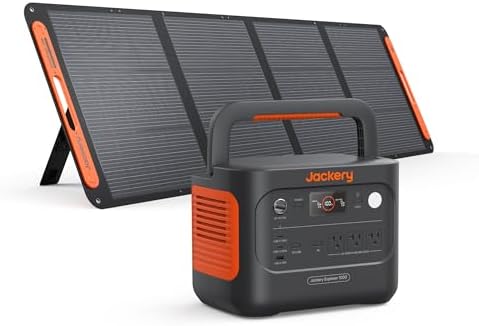
2. Jackery Solar Generator 1000 v2 + 200W Panel — Best Value
- Powerful yet Compact: Boasting a 1,500W AC output and a 3,000W surge peak, the Solar Generator 1000 V2 can power multipl…
- One Hour Fast Charging: Charge your Explorer 1000 v2 Portable Power Station from 0% to 100% battery level in just one ho…
- 10 Year Lifespan: The Explorer 1000 v2 portable power station is equipped with a durable LFP battery, maintaining over 7…
Key Specs
- Capacity: 1,070Wh LiFePO4, 4,000 cycles to 70% capacity
- Output: 1,500W AC, 3,000W surge; 3 AC, 2 USB-C (100W PD), 1 USB-A, 1 car port
- Weight: 23.8 lbs with folding handle
- Charging: 1-hour emergency AC charge via app (1.7 hours default); 3 hours with a 600W alternator charger; about 80% in 6 hours from the 200W panel
- Extras: App with quiet 30 dB overnight charging mode
- Coverage: 5 years
- Amazon rating: 4.5/5 from 1,400+ owners
Who this is for: Weekend campers, van-lifers and small trailer owners who want a proven, easy-to-carry kit at a mid-range price.
The Explorer 1000 v2 is Jackery’s balance point between capacity and portability. At 23.8 pounds, you can carry it from the trailer to the picnic table to run a blender, string lights or a projector, and stow it under a dinette seat when you’re on the road. The 1,070Wh battery covers a fridge, lights and devices for a day, and longer if you’re careful.
Charging is where the v2 stands out at this tier. Through the Jackery app you can enable a one-hour emergency charge from the wall, handy for a quick top-up at a campground before heading to dispersed sites. Default charging takes about 1.7 hours to protect battery health, and there’s a quiet overnight mode rated at 30 dB if the unit charges inside the camper while you sleep. On the road, a 600W alternator charger can fill it in about three hours.
The trade-off is solar. A single 200W panel gets you to about 80% in six hours of good sun, which is fine for light use but won’t keep up with heavy daily loads. If you plan to stay off-grid for several days with a fridge running, add a second panel or step up to a 2kWh kit.
What I liked:
- Light and portable for a 1kWh-class unit
- One-hour emergency AC charging and quiet overnight mode
- LiFePO4 battery with 5 years of coverage
What could be better:
- One 200W panel is slow for heavy daily use
- 1,500W inverter won’t handle large appliances
Bottom line: The best value solar generator for RV weekends and smaller rigs.
3. EcoFlow DELTA 3 Classic + 220W Panel — Best for Fast Charging
- *To ensure prompt arrived, please note that the DELTA 3 Classic Solar Generator and 220W Solar Panel will be arrived sep…
- Power for Every Scenario: EcoFlow DELTA 3 Classic delivers 1800W output (3600W surge) with X-Boost technology—enough for…
- Ultra-Fast Charging: Go from 0–80% in just 45 minutes with X-Stream AC charging. Keep your devices and appliances powere…
Key Specs
- Capacity: 1,024Wh LiFePO4, rated for 10+ years of daily use
- Output: 1,800W AC (3,600W surge); X-Boost up to 2,600W for resistive loads
- AC charging: 0–80% in about 45 minutes with X-Stream
- Solar: 220W bifacial N-type panel, up to 25% efficiency; about 5.8 hours to recharge
- UPS: Switches to battery in under 10ms
- Amazon rating: 4.6/5 from 380+ owners
Who this is for: RVers who hop between hookups and dry camping, and anyone who also wants a home backup unit for outages.
EcoFlow’s calling card is charging speed, and the DELTA 3 Classic delivers: about 45 minutes from 0 to 80% on AC. If your travel pattern mixes a night at a full-hookup campground with a couple of nights off-grid, that means you can roll out with a nearly full battery after a short plug-in. The bifacial 220W panel captures light on both sides and EcoFlow rates it for a full recharge in about 5.8 hours.
The 1,800W inverter is a step up from the Jackery 1000 v2, and X-Boost lets it run some higher-wattage resistive devices at reduced power. The under-10ms UPS switchover is a bonus at home: plug in a router, computer or CPAP and the DELTA 3 Classic takes over almost instantly if the grid drops.
The trade-off is capacity. At 1,024Wh it’s in the same class as the Jackery, so multi-day boondocking with a fridge still calls for careful energy budgeting or a second panel. Note that the station and panel may arrive in separate shipments.
What I liked:
- Very fast 45-minute AC charge to 80%
- Efficient bifacial 220W panel included
- Sub-10ms UPS doubles as home backup
What could be better:
- 1kWh capacity limits long off-grid stays
- Single panel in the kit
Bottom line: The pick for travelers who want the fastest recharge and a unit that pulls double duty as home backup.
4. BLUETTI Elite 300 + 2x200W Panels — Best for Full-Timers
- [Harness Solar Energy] – This solar generator kit includes an Elite 300 power station and 2×200W solar panels, enable yo…
- [Compact 3kWh Power — Verified by Frost & Sullivan] – Elite 300 packs a full 3014Wh capacity into an ultra-compact desig…
- [RV-Ready Power Ports] – Features a dedicated TT-30 outlet and a 12V/30A DC port for seamless, adapter-free connection t…
Key Specs
- Capacity: 3,014.4Wh LiFePO4
- Output: 2,400W AC (4,800W surge)
- RV ports: Dedicated TT-30 outlet plus 12V/30A DC port
- Solar: 2 x 200W panels included; about 7–15 hours to full depending on conditions
- Size: Described by BLUETTI as the smallest 3kWh portable power station, about 59% smaller than traditional large units
- Amazon rating: 4.7/5 from 240+ owners
Who this is for: Full-time and long-stay RVers who want to plug the rig straight into the power station and stay off-grid for days.
The headline feature for RVers is the TT-30 outlet. That’s the same 30-amp plug your RV uses at a campground pedestal, so you can connect your shore power cord directly instead of running extension cords to individual appliances. Add the 12V/30A DC port for the fridge or 12V systems, and the Elite 300 behaves much more like a built-in house battery bank than a camping gadget.
With 3,014Wh on board, you have room for real loads: a residential fridge, lights, fans, a TV and devices, with capacity left over. The 2,400W inverter and 4,800W surge help start resistive loads like kettles. BLUETTI positions it for home backup too, listing fridges, routers, TVs and CPAP machines among the essentials it can keep running during an outage.
The trade-offs are cost and solar math. It sits in the premium tier, and 400W of panels takes roughly 7 to 15 hours to fill a 3kWh battery, so heavy users will want more panel wattage or alternator charging. Running a rooftop air conditioner is possible on large stations but drains even 3kWh quickly; plan on short cooling sessions rather than all-day AC.
What I liked:
- TT-30 outlet connects your RV shore cord directly
- 3kWh capacity in a compact body
- Strong 2,400W inverter with 4,800W surge
What could be better:
- Premium price tier
- 400W of panels is slow to refill 3kWh
Bottom line: The closest thing to a plug-and-play RV power system in this roundup.
5. Jackery Solar Generator 300 + 40W Panel — Best Budget Pick
- Ultra-Lightweight: Weighing only 7.5 lbs, the new Explorer 300 is 17% lighter than the industry average for its class. T…
- Versatile Power for 6 Devices: Equipped with 2 AC outlets, a 100W USB-C PD port, 2 USB-A ports, and a 120W car port. Wit…
- Built to Last: Upgraded with premium LiFePO4 chemistry, this portable generator delivers over 4,000 charge cycles before…
Key Specs
- Capacity: 292Wh LiFePO4, 4,000 cycles to 70%
- Output: 300W AC (600W surge); 2 AC, 100W USB-C PD, 2 USB-A, 120W car port
- Weight: 7.5 lbs
- Solar: 40W panel included (about 80% in 7.5 hours); about 80% in 2.8 hours with an optional 100W panel
- Amazon rating: 4.4/5 from 200+ owners
Who this is for: Teardrop and pop-up campers, tent-plus-car campers, and RVers who want a small backup for devices and lights.
Not every camper needs a 2kWh battery. If your power needs are phones, a laptop, camera batteries, LED lights and a small fan, the Jackery Solar Generator 300 handles them at a fraction of the weight and cost. At 7.5 pounds it’s easy to carry from the campsite to a picnic table, and the 100W USB-C port charges most laptops directly.
The LiFePO4 battery is a nice upgrade at this size, with Jackery rating it for 4,000 cycles before dropping to 70% capacity. The included 40W panel is best thought of as a trickle charger; if you’ll depend on solar, a 100W panel brings it to about 80% in under three hours of good sun.
The limit is obvious: 292Wh and 300W won’t run a fridge, coffee maker or microwave. Treat it as a device and lighting station, not an RV power system. As a second, grab-and-go unit alongside a larger station, it’s handy too.
What I liked:
- Very light and easy to carry
- LiFePO4 battery with long cycle life
- 100W USB-C for laptops
What could be better:
- Too small for fridges or kitchen appliances
- 40W panel is slow
Bottom line: The budget way to keep devices and lights powered on short trips.
How to Choose a Solar Generator for RV Camping
Size Your Battery to a Real Day
Add up what you’ll run in 24 hours. A 12V compressor fridge might use 500–1,000Wh a day depending on size and weather; LED lights 50–100Wh; a roof fan 100–300Wh; phones and laptops 100–200Wh; a CPAP 300–600Wh. Most couples land between 1,000 and 2,000Wh per day. Pick a battery that covers at least one full day with margin, then plan to refill it with solar.
Inverter Output and Surge
The inverter limits what you can plug in at once. 1,500–1,800W runs most small appliances one at a time. 2,400–2,600W handles a coffee maker or microwave with other loads. Surge ratings matter for motors and compressors that spike at startup. Running a rooftop AC is possible on large stations, but it will drain the battery quickly.
Solar Wattage and Recharge Time
Rated panel wattage is a best case. In real conditions, plan on getting roughly 60–80% of rated output during peak sun. Two 200W panels are a good baseline for a 2kWh battery; a 3kWh battery benefits from more. Bifacial panels like EcoFlow’s can capture extra light reflected off the ground.
RV Connections: TT-30, 12V and Alternator Charging
A TT-30 outlet (BLUETTI Elite 300) lets you plug your RV’s 30-amp shore cord straight in. A 12V/30A DC port feeds 12V appliances efficiently. Alternator chargers (available for BLUETTI and Jackery) let you refill while driving, which is often faster than solar on travel days.
Battery Chemistry
All five picks use LiFePO4 (lithium iron phosphate) batteries, which last thousands of cycles and are more thermally stable than older NMC lithium. For RV use, where the unit cycles almost daily, LiFePO4 is the right choice.
Budget vs Mid-range vs Premium
Budget kits power devices and lights. Mid-range 1kWh kits cover a weekend with a fridge if you’re careful. Upper mid-range 2kWh kits are the sweet spot for most RVers. Premium 3kWh systems with RV-specific ports suit full-timers. If you’re tracking power at home too, our guide to the best smart plugs with energy monitoring shows exactly what your appliances draw, which makes sizing a solar generator far easier. Planning movie nights at camp? Our best mini projector for bedroom picks are compact and low-wattage enough to run from a power station, and our best wireless meat thermometer for smoker guide covers the campfire cooking side.
Frequently Asked Questions
What size solar generator do I need for an RV?
Most couples use 1,000–2,000Wh per day running a fridge, lights, fans and devices. A 2kWh solar generator with about 400W of panels suits most RVers. Weekend campers with light loads can use 1kWh; full-timers often want 3kWh or more.
Can a solar generator run an RV air conditioner?
Large units can start and run a rooftop AC for a while, but even a 3kWh battery drains quickly at 1,300W or more of continuous draw. Plan for short cooling sessions, or use shore power or a gas generator for all-day AC.
Can a solar generator power an RV refrigerator?
Yes. A 12V compressor fridge or a residential fridge can run from a 1kWh-plus solar generator. Daily use typically ranges from 500 to 1,000Wh or more, so size the battery and panels to match.
Can I plug my RV directly into a solar generator?
Only if it has a TT-30 outlet or you use an adapter. The BLUETTI Elite 300 includes a TT-30 port, so you can connect your 30-amp shore cord directly. Check the inverter limit, since the station can’t supply a full 30 amps of continuous power at once.
How long does it take to charge a solar generator with solar panels?
It depends on panel wattage and sun. Manufacturer ratings in this roundup range from about 5.5 hours (2kWh with 400W of panels) to 7–15 hours (3kWh with 400W). Real-world times are usually longer than ideal-condition ratings.
Is a solar generator better than a gas generator for RV camping?
Solar generators are silent, fume-free and allowed during campground quiet hours, with no fuel to carry. Gas generators deliver more continuous power for heavy loads like air conditioning. Many RVers use solar for daily needs and keep a small gas generator for occasional heavy use.
Can you charge a solar generator while driving?
Yes, with a 12V car port (slow) or an alternator charger (fast). Jackery rates its 600W alternator charger at about 3 hours for the 1000 v2, and BLUETTI offers a 1,200W alternator charger for the Elite 200 V2.
How long do LiFePO4 solar generators last?
Thousands of cycles. Ratings in this roundup range from 4,000 cycles to 70% capacity (Jackery) to 6,000+ cycles (BLUETTI Elite 200 V2), which translates to roughly a decade of regular use.
What is the best solar generator for RV use in 2026?
For most RVers, the BLUETTI Elite 200 V2 with two 200W panels offers the best mix of capacity, output and charging. Choose the Jackery 1000 v2 for value, EcoFlow DELTA 3 Classic for fast charging, BLUETTI Elite 300 for full-timers, and the Jackery 300 for devices-only budgets.
Final Verdict
The BLUETTI Elite 200 V2 with two 200W panels is the best solar generator for RV camping for most people: 2kWh of LiFePO4 capacity, a 2,600W inverter, fast AC/DC charging and very low standby draw. The Jackery Solar Generator 1000 v2 is the best value for weekend trips and smaller rigs. The EcoFlow DELTA 3 Classic wins on charging speed and doubles as home backup. Full-timers should look at the BLUETTI Elite 300 for its TT-30 RV outlet and 3kWh capacity, while the Jackery Solar Generator 300 is the budget pick for devices and lights.
- Powerful yet Compact: Boasting a 1,500W AC output and a 3,000W surge peak, the Solar Generator 1000 V2 can power multipl…
- One Hour Fast Charging: Charge your Explorer 1000 v2 Portable Power Station from 0% to 100% battery level in just one ho…
- 10 Year Lifespan: The Explorer 1000 v2 portable power station is equipped with a durable LFP battery, maintaining over 7…
- *To ensure prompt arrived, please note that the DELTA 3 Classic Solar Generator and 220W Solar Panel will be arrived sep…
- Power for Every Scenario: EcoFlow DELTA 3 Classic delivers 1800W output (3600W surge) with X-Boost technology—enough for…
- Ultra-Fast Charging: Go from 0–80% in just 45 minutes with X-Stream AC charging. Keep your devices and appliances powere…
- [Quite Power from Sunlight] – This solar generator kit includes an Elite 200 V2 power station and 2×200W solar panels, f…
- [The Most-Efficiency 2kWh Power] – An advanced energy management system and high-efficiency components reduce standby po…
- [Longest Lifespan of 17-Year] – Equiped with the industry’s first CNAS-certified true automotive-grade LiFePO4 battery, …
- Ultra-Lightweight: Weighing only 7.5 lbs, the new Explorer 300 is 17% lighter than the industry average for its class. T…
- Versatile Power for 6 Devices: Equipped with 2 AC outlets, a 100W USB-C PD port, 2 USB-A ports, and a 120W car port. Wit…
- Built to Last: Upgraded with premium LiFePO4 chemistry, this portable generator delivers over 4,000 charge cycles before…
- [Harness Solar Energy] – This solar generator kit includes an Elite 300 power station and 2×200W solar panels, enable yo…
- [Compact 3kWh Power — Verified by Frost & Sullivan] – Elite 300 packs a full 3014Wh capacity into an ultra-compact desig…
- [RV-Ready Power Ports] – Features a dedicated TT-30 outlet and a 12V/30A DC port for seamless, adapter-free connection t…
See full specs on BLUETTI’s official site.
Last updated: October 2026 | Prices subject to change.
Questions about any of these picks? Get in touch via our contact page.