This post contains affiliate links. As an Amazon Associate, I earn from qualifying purchases at no extra cost to you.
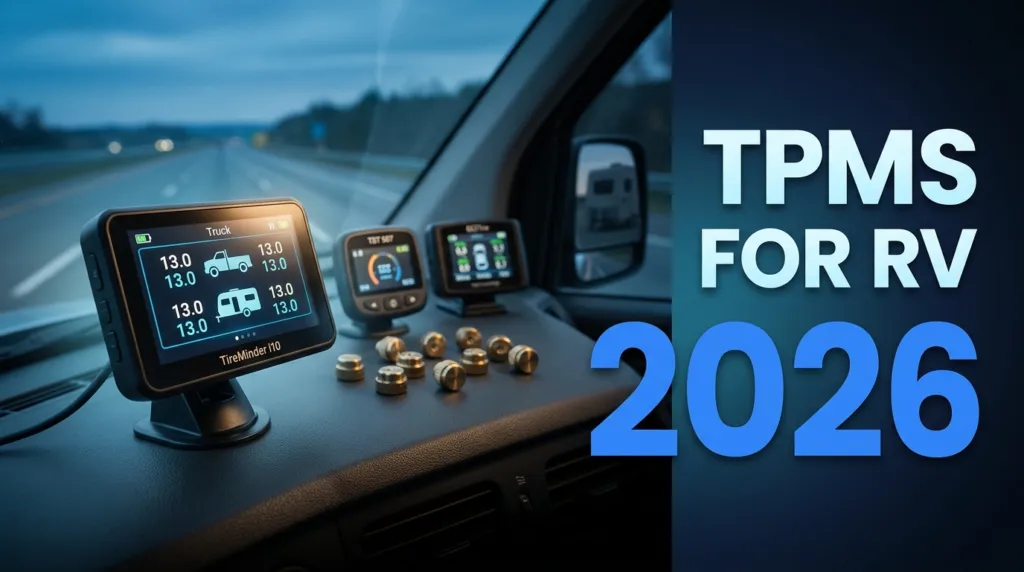
The best TPMS for RV owners is the one that keeps talking to every tire on your rig — including the back axle of a 35-foot fifth wheel — and warns you early enough to pull over before a slow leak turns into a shredded tire and a torn-up wheel well. On paper, most RV tire pressure monitoring systems look the same: a dash display, screw-on sensors and a list of alarms. In real use, the differences come down to signal reliability, how many tires the system can handle, sensor type, and how it behaves when something goes wrong fast.
We compared RV TPMS kits sold on Amazon, read verified owner reviews (including the critical ones), and lined up the specs that matter for towing: sensor count, pressure range, number of tires supported, booster/repeater, display and warranty. Here are five picks — from a budget six-sensor kit to systems that can track a motorhome and its tow car at the same time.
Quick Picks
- Best overall: TireMinder i10 — 4 transmitters plus a signal booster, monitors up to 20 tires at once and stores 4 vehicles.
- Best for long-term reliability and support: TST 507 Series (6 cap sensors) — color display, repeater included, three-year warranty, USA-based support.
- Best for big rigs: EEZTire TPMS6ATC — anti-theft sensors, pressures up to 210 psi, expandable to 26 tires.
- Best for motorhome + toad: GUTA GT80 (12 sensors) — 4.3″ touchscreen, pre-paired sensors, shows up to 22 tires on one page.
- Best budget six-sensor kit: Tymate TM2 (6 sensors + booster) — solar/USB-C charging display.
How We Picked
We didn’t install these on our own rigs. We did the research a careful RVer would do before spending a few hundred dollars:
- Specs that matter for towing: sensor count, pressure range (heavy motorhome tires can run above 100 psi), maximum tires, booster/repeater, alert types and display.
- Owner reviews by model and sensor count, with extra weight on critical reviews to find failure patterns — signal dropouts, valve stem problems, dim screens and battery life.
- Support and warranty, because sensors eventually need batteries, replacements or re-pairing.
My Top Pick — TireMinder i10
The TireMinder i10 is the system we’d buy first for most travel trailers and fifth wheels. It checks every tire every 6 seconds for slow leaks, rapid leaks, blowouts, low and high pressure and high temperature, reads 0–199 psi with ±1 psi accuracy, and ships with TireMinder’s signal booster — the single biggest fix for RV signal dropouts. It has a long owner track record, and owners who switched from other systems frequently say it’s the first one that held signal on their rig.

- Large 3.15″ Color LCD featuring simultaneous PSI or Temperature Readings
- Checks for the following tire issues every 6 seconds: slow leaks, rapid leaks, blowouts, low pressure, high pressure and…
- Monitors up to 40 tires, from 0-199 psi, with +/- 1 PSI accuracy
Price as of Nov 5, 2026, 3:37 PM UTC. Product prices and availability are accurate as of the date/time indicated and are subject to change. Any price and availability information displayed on Amazon.com at the time of purchase will apply to the purchase of this product.
Best TPMS for RV — Comparison


Price as of Nov 5, 2026, 3:37 PM UTC. Product prices and availability are accurate as of the date/time indicated and are subject to change. Any price and availability information displayed on Amazon.com at the time of purchase will apply to the purchase of this product.
Live prices appear in the product boxes above and below.
TPMS for RV Reviews — Detailed Breakdown
1. TireMinder i10 — Best Overall TPMS for RV
- Large 3.15″ Color LCD featuring simultaneous PSI or Temperature Readings
- Checks for the following tire issues every 6 seconds: slow leaks, rapid leaks, blowouts, low pressure, high pressure and…
- Monitors up to 40 tires, from 0-199 psi, with +/- 1 PSI accuracy
Price as of Nov 5, 2026, 3:37 PM UTC. Product prices and availability are accurate as of the date/time indicated and are subject to change. Any price and availability information displayed on Amazon.com at the time of purchase will apply to the purchase of this product.
Key Specs
- In the box: i10 monitor, 4 transmitters, Rhino signal booster
- Monitors up to 20 tires at once; stores up to 4 vehicles (40 tires)
- Displays up to 10 tires at once, swapping automatically between towing and towed vehicle
- Range: 0–199 psi, ±1 psi accuracy; checks every 6 seconds
- Alerts: slow leak, rapid leak, blowout, low/high pressure, high temperature
- 3.15″ color LCD showing pressure or temperature
Who this is for: Travel trailer and fifth-wheel owners who want a dedicated dash display (no phone app) that holds signal reliably.
Signal is the silent problem with RV TPMS. Sensors on the back axle of a long trailer are 30–40 feet from the cab, separated by aluminum, steel and a truck bed full of gear. When a system loses a sensor, cheaper displays often just keep showing the last reading — which is worse than no reading at all. The i10 ships with TireMinder’s booster in the box, and that’s the most consistent theme in owner reviews: owners who had tried other TPMS kits that kept throwing “no signal” alarms often say the i10 was the first to hold all sensors, including on long truck-and-trailer setups.
The 0–199 psi range covers trailer tires and most motorhome tires, and ±1 psi accuracy is tight enough to catch a slow leak trend before it’s dangerous. Being able to store four vehicles is handy if you switch between a camper and a utility or boat trailer.
What owners report: Owners often describe it as reliable, easy to install and accurate, and worth the money for peace of mind. The criticisms: some owners still see occasional signal loss, a few mention screen cracks or durability issues over time or wish the display were brighter, and some report valve stem problems on factory rubber stems — a common issue with any screw-on sensor (see the valve stem section below).
Why we picked it:
- Booster included — the biggest single fix for signal dropouts
- Tracks multiple vehicles and up to 20 tires at once
- Long owner track record
What could be better:
- Only 4 transmitters in the box — a tandem trailer plus tow vehicle needs more
- Smaller screen than the EEZTire and GUTA
- Some reports of screen durability issues
Skip it if: you want six or more sensors in the box without buying add-ons — the TST 507, EEZTire and Tymate kits include six, and the GUTA GT80 includes 12.
2. TST 507 Series (6 Cap Sensors) — Best for Long-Term Reliability and Support
- Safety Monitoring: Alerts for low pressure, high pressure, fast leaks, high temperature; Audible and visual alerts with …
- Premium Display: Compact 3.5-inch color display with rechargeable battery; Includes Micro-USB charger; Features suction …
- Expandable System: Can monitor your towing truck and up to four towable vehicles; Easily swap tire locations after rotat…
Price as of Nov 5, 2026, 3:37 PM UTC. Product prices and availability are accurate as of the date/time indicated and are subject to change. Any price and availability information displayed on Amazon.com at the time of purchase will apply to the purchase of this product.
Key Specs
- In the box: 3.5″ color display, 6 cap sensors, repeater, magnetic mount, charging cable
- Alerts: low and high pressure, fast leak, high temperature; audible and visual, auto-locks on the problem tire
- Monitors the tow vehicle plus up to four towable vehicles; easy to swap tire positions after rotation
- Rechargeable display with suction-cup and rubber dash mounts
- User-replaceable CR2032 sensor batteries; low-battery alerts
- Three-year warranty; USA-based live customer service
Who this is for: Full-timers and frequent travelers who want a well-established system with strong support and a long warranty.
Truck System Technologies’ 507 series is one of the longest-running RV TPMS lines, and owners often mention using it for many years and buying it again for a second rig. The three-year warranty is the longest in this roundup, and USA-based live support matters when you’re trying to re-pair a sensor at a campground.
The “auto-lock on problem tire” feature is more useful than it sounds — when an alarm triggers, the display stays on the affected tire instead of cycling through the others, so you can watch the pressure trend while you find a safe place to stop. The included repeater solves most range issues on long rigs.
What owners report: Owners often describe setup as straightforward with clear directions, readings as accurate and the system as a must-have for RV safety. Mixed areas: programming takes patience for some, and the screen can be hard to read in direct sunlight. One practical note: the repeater wires to a battery, and unless it’s on a switched circuit it creates a small constant drain — consider a battery disconnect or switched lead. Several owners said syncing takes effort, but once done it just works.
Why we picked it:
- Three-year warranty and USA-based support
- Six sensors and a repeater in the box
- Long track record with repeat buyers
What could be better:
- Premium price tier
- Programming has a learning curve
- Display can wash out in bright sun
Skip it if: you only tow a small single-axle trailer — a four-sensor kit is enough.
3. EEZTire TPMS6ATC — Best for Big Rigs and High Pressures
- REAL TIME/24×7 SAFETY & HIGH FUEL ECONOMY – EezTire TPMS system by EEZ RV Products is the industry leader in the RV TPMS…
- ADVANCED TECHNOLOGY ALERT SYSTEM – the monitor is motion sensitive and monitors tire pressure and temperature on 6-secon…
- EASY OPERATION & MAINTENANCE – EezTire TPMS monitor has one of the largest display screen on the market 4 ½” x 3”. It ta…
Price as of Nov 5, 2026, 3:37 PM UTC. Product prices and availability are accurate as of the date/time indicated and are subject to change. Any price and availability information displayed on Amazon.com at the time of purchase will apply to the purchase of this product.
Key Specs
- In the box: color monitor + 6 anti-theft sensors
- Monitors pressure and temperature on 6-second intervals; handles up to 210 psi
- Expandable from 4 to 26 sensors; separate controls for RV and trailer
- Large 4½” x 3″ display; motion-sensitive power saving after 15 minutes
- Internal rechargeable battery rated up to 60 hours; replaceable sensor batteries
- Supports anti-theft and flow-through sensors; optional booster
Who this is for: Class A and big Class C owners, heavy fifth wheels and anyone running high tire pressures or lots of axles.
EEZ RV Products has been making RV TPMS since 2005, and the TPMS6ATC is built for big setups. The 210 psi ceiling is the highest here — useful for heavy motorhome tires — and the system scales all the way to 26 sensors. The anti-theft sensors lock onto the valve stem so they can’t simply be unscrewed at a campground, and the separate RV/trailer controls let you switch off trailer monitoring when you drive the motorhome solo.
The display is also the largest among the button-operated systems, which matters when you’re glancing at it while driving a 40-foot rig.
What owners report: Owners often praise easy installation, accurate readings and long-term reliability, and some credit the fast-leak alarm with saving a rim and tire. Mixed areas: some sensors occasionally lose signal and have to re-acquire, and opinions on sensor battery life vary (some report 2–3 years). Some owners also mention compatibility problems pairing older sensors with a new monitor, so plan on replacing old sensors when you upgrade the display.
Why we picked it:
- 210 psi capacity and expandable to 26 tires
- Anti-theft sensors
- Large display with separate RV/trailer controls
What could be better:
- Booster sold separately
- Older sensors may not pair with newer monitors
- Premium price tier
Skip it if: you run a small trailer and want a booster in the box — the TireMinder or Tymate kits include one.
4. GUTA GT80 (12 Sensors) — Best for Motorhome + Tow Car
- Full-Color Touchscreen for Real-Time Monitoring: The GUTA GT80 RV TPMS has a 4.3-inch full-color touchscreen that provid…
- Advanced Alert System: This RV tire pressure monitoring system (TPMS) displays up to 22 tires’ data on one page and feat…
- Easy Setup & Customizable Settings: All sensors included in the package are pre-labeled and paired with the monitor at t…
Price as of Nov 5, 2026, 3:37 PM UTC. Product prices and availability are accurate as of the date/time indicated and are subject to change. Any price and availability information displayed on Amazon.com at the time of purchase will apply to the purchase of this product.
Key Specs
- In the box: 4.3″ color touchscreen + 12 sensors + signal booster
- Pressure 0–188 psi; temperature up to 185°F
- Displays up to 22 tires on one page; 5 selectable vehicle types
- 6 alarm modes: high/low pressure, high temperature, fast leak, missing signal, low sensor battery
- Sensors pre-labeled and pre-paired at the factory
- Range up to 164 ft with booster (repeater recommended for trailers 40 ft+)
Who this is for: Motorhome owners who flat-tow or dolly-tow a car, or anyone with lots of tires who wants them all on one screen.
Twelve sensors in one box is the main reason to buy the GT80: that covers a six-wheel motorhome plus a four-wheel tow car, with two to spare. The 4.3″ touchscreen showing up to 22 tires on a single page is easier to read at a glance than displays that cycle tire by tire, and the “missing signal” alarm tells you when a sensor stops reporting — something cheaper systems don’t always do.
What owners report: Owners often mention easy setup because sensors arrive pre-paired. Note that alarm thresholds are percentage-based (+25% / −15% from the pressure when you set it) rather than fully custom. Two cautions come up: the sensors’ weight can stress older trailer valve stems, and new sensors may not be compatible with an older GUTA display. The listing’s owner track record is still fairly short.
Why we picked it:
- 12 pre-paired sensors and a booster in one box
- Touchscreen showing up to 22 tires on one page
- Missing-signal and low-battery alarms
What could be better:
- Alarm thresholds are percentage-based
- Smaller review base than TST, EEZ or TireMinder
- Sensor versions may not mix across GUTA generations
Skip it if: you only have four to six tires to monitor — you’d be paying for sensors you won’t use.
5. Tymate TM2 (6 Sensors + Booster) — Best Budget Six-Sensor RV TPMS
- [Solar Charging and USB Charging]: The Tymate Tire Pressure Monitoring System offers two convenient charging options. Eq…
- [Advanced Real-time Monitoring & Easy Setup]: Explore Five Alarm Modes and Easy Setup for Alarm Thresholds With the Tyma…
- [Extending Range with Repeaters & Ensuring Precision with Sensors]: The Tymate Tire Pressure Monitoring System TM2 featu…
Price as of Nov 5, 2026, 3:37 PM UTC. Product prices and availability are accurate as of the date/time indicated and are subject to change. Any price and availability information displayed on Amazon.com at the time of purchase will apply to the purchase of this product.
Key Specs
- In the box: color display, 6 external sensors, booster kit
- Pressure 0–144 psi; monitors up to 10 tires
- Alarms: fast leak, high/low pressure, high temperature, low sensor voltage
- Display charges by solar panel or USB-C; power-saving after 10 minutes stationary
- Sensor battery life rated up to 2 years; accuracy within 3 psi
Who this is for: Budget-minded owners of tandem-axle travel trailers who want six sensors and a booster without paying premium prices.
The TM2 kit gives you six sensors plus a booster at a budget price tier, and the solar-charging display means you’re not hunting for a USB port on every trip. Several owners report it working out of the box, with accurate readings and reliable signal on long trips.
What owners report — read this before buying: Owners often find the display dim, small and hard to see in direct sunlight, and it shows the first four tires, then flashes to the “trailer” screen for the remaining two rather than showing all six at once. Most seriously, at least one owner reported normal readings for several minutes after a fifth-wheel tire completely shredded. That’s a reminder that no TPMS can promise to catch a sudden blowout — sensors report on intervals, and a sensor can be destroyed along with the tire. TPMS is best at catching the slow leaks and heat build-up that cause most blowouts.
Why we picked it:
- Six sensors and a booster at a budget price tier
- Solar + USB-C charging display
- Many owners report reliable signal
What could be better:
- Dim, small screen that’s hard to read in sun
- Cycles between screens instead of showing all six tires
- Lowest pressure ceiling here (144 psi) — not for high-pressure motorhome tires
Skip it if: you drive a heavy motorhome or want a premium warranty and support.
What a TPMS Can and Can’t Do
A TPMS is excellent at catching the slow problems that cause most RV tire failures: gradual leaks, under-inflation and heat build-up from an overloaded or dragging wheel. It’s much less reliable at warning you about a sudden, instantaneous failure — a road-debris puncture that shreds the tire can destroy the sensor before it reports. That’s why owner reviews range from owners crediting a fast-leak alert with saving a rim to owners who got no warning before a catastrophic blowout. Treat a TPMS as an early-warning system, not a guarantee, and keep checking tire age, load and cold pressure before every trip. The NHTSA tire safety page is a good refresher.
How to Choose a TPMS for RV
1. Count your tires — all of them
Add up the tow vehicle, every trailer axle and any towed car. A tandem travel trailer is 4 tires; with the truck it’s 8 (10 with dually rear wheels). A Class A with a tow car is often 10. Buy a system that supports your total now, with room to grow.
2. Plan for signal range
Long trailers and fifth wheels are where signal drops happen. A booster or repeater mounted mid-rig fixes most problems. TireMinder, TST, GUTA and Tymate include one; EEZTire sells it separately. As a rule of thumb from owners and manufacturers, plan on a repeater for rigs around 25–40 feet and longer.
3. Cap sensors vs. flow-through vs. anti-theft
Cap sensors screw onto the valve stem and are easiest to install. Flow-through sensors let you add air without removing them. Anti-theft sensors lock onto the stem so they can’t be easily stolen. Choose flow-through if you top up tires often.
4. Upgrade to metal valve stems
Screw-on sensors add weight to the valve stem, and on rubber stems that weight plus centrifugal force can lead to cracking or leaks — several owners in this roundup ran into exactly that. Many RV owners and tire shops recommend switching to metal (high-pressure) valve stems when installing a TPMS.
5. Match pressure range to your tires
Trailer tires typically run 50–80 psi, but heavy motorhome tires can exceed 100 psi. Make sure the system’s maximum comfortably exceeds your tires’ cold inflation pressure.
6. Display you can actually read
A display that shows all your tires on one page, stays readable in sunlight, and locks onto the problem tire during an alarm is worth more than extra features.
Building out your RV setup? See our best solar generator for RV picks, our best dash cam for truckers guide for long-haul recording, and the best jump starter for diesel trucks for your tow vehicle. For full manufacturer specs, visit TireMinder and EEZ RV Products.
Related guides: Best Wireless Backup Camera for RV
Frequently Asked Questions
Is a TPMS worth it for an RV?
For most RVers, yes. Trailer tires are out of sight and a failing tire often goes unnoticed from the cab until it shreds and damages the wheel well. A TPMS catches slow leaks and overheating early, and many owners credit fast-leak alerts with saving a tire or rim.
How many sensors do I need for my RV TPMS?
One per tire you want to monitor. A single-axle trailer needs 2, a tandem 4, a triple-axle 6. Add the tow vehicle’s tires if you want to monitor those too, and a toad’s tires if you flat-tow a car.
Do I need a repeater for my RV TPMS?
For longer rigs, usually yes. Owners commonly recommend a repeater for trailers around 25 feet and up, and manufacturers like GUTA recommend one for rigs 40 feet and longer. Short trailers often work without one.
Can a TPMS detect a blowout?
Sometimes, but not reliably. Sensors report on intervals (often every 6 seconds), and a sudden failure can destroy the sensor. A TPMS is best at catching the slow leaks and heat that lead to blowouts.
Are cap sensors bad for RV valve stems?
They can stress rubber valve stems, especially on older tires. Switching to metal valve stems is a common, inexpensive fix that many RV owners recommend when installing a TPMS.
How long do RV TPMS sensor batteries last?
It varies by brand and use. Tymate rates its sensors for up to 2 years; owners of EEZTire systems report anywhere from 2–3 years to 5 years. Most systems use user-replaceable coin-cell batteries and give low-battery alerts.
Can I use one TPMS for my truck and trailer?
Yes. TST, TireMinder and EEZTire systems can monitor a tow vehicle plus one or more towables, and the TireMinder i10 can store up to four vehicles.
What tire pressure should my RV tires be?
Use the pressure on the RV’s tire placard or the tire manufacturer’s load and inflation table for your actual axle weights — measured cold, before driving. Don’t use the TPMS reading after driving to set pressure, because hot tires read higher.
Is a TPMS for RV worth it in 2026?
Yes, if you tow or drive an RV more than a few times a year. Compared with the cost of a blown tire, wheel and body damage, a good TPMS is cheap insurance — as long as you treat it as an early warning, not a guarantee.
Final Verdict
For most travel trailers and fifth wheels, the TireMinder i10 is the best TPMS for RV owners: reliable signal with the included booster, accurate readings and multi-vehicle memory. Choose the TST 507 Series if you want six sensors, a three-year warranty and USA-based support; the EEZTire TPMS6ATC for big motorhomes and high pressures; the GUTA GT80 if you need 12 sensors for a motorhome and tow car; and the Tymate TM2 if you want six sensors and a booster on a tight budget.
- REAL TIME/24×7 SAFETY & HIGH FUEL ECONOMY – EezTire TPMS system by EEZ RV Products is the industry leader in the RV TPMS…
- ADVANCED TECHNOLOGY ALERT SYSTEM – the monitor is motion sensitive and monitors tire pressure and temperature on 6-secon…
- EASY OPERATION & MAINTENANCE – EezTire TPMS monitor has one of the largest display screen on the market 4 ½” x 3”. It ta…
- Safety Monitoring: Alerts for low pressure, high pressure, fast leaks, high temperature; Audible and visual alerts with …
- Premium Display: Compact 3.5-inch color display with rechargeable battery; Includes Micro-USB charger; Features suction …
- Expandable System: Can monitor your towing truck and up to four towable vehicles; Easily swap tire locations after rotat…
- Large 3.15″ Color LCD featuring simultaneous PSI or Temperature Readings
- Checks for the following tire issues every 6 seconds: slow leaks, rapid leaks, blowouts, low pressure, high pressure and…
- Monitors up to 40 tires, from 0-199 psi, with +/- 1 PSI accuracy
- [Solar Charging and USB Charging]: The Tymate Tire Pressure Monitoring System offers two convenient charging options. Eq…
- [Advanced Real-time Monitoring & Easy Setup]: Explore Five Alarm Modes and Easy Setup for Alarm Thresholds With the Tyma…
- [Extending Range with Repeaters & Ensuring Precision with Sensors]: The Tymate Tire Pressure Monitoring System TM2 featu…
- Full-Color Touchscreen for Real-Time Monitoring: The GUTA GT80 RV TPMS has a 4.3-inch full-color touchscreen that provid…
- Advanced Alert System: This RV tire pressure monitoring system (TPMS) displays up to 22 tires’ data on one page and feat…
- Easy Setup & Customizable Settings: All sensors included in the package are pre-labeled and paired with the monitor at t…
Price as of Nov 5, 2026, 3:37 PM UTC. Product prices and availability are accurate as of the date/time indicated and are subject to change. Any price and availability information displayed on Amazon.com at the time of purchase will apply to the purchase of this product.
Specs come from manufacturer listings; owner feedback comes from verified Amazon reviews.
Questions about any of these picks? Get in touch via our contact page.