
This post contains affiliate links. As an Amazon Associate, I earn from qualifying purchases at no extra cost to you.
If you’ve just switched to a standing desk, the first few weeks can be rough. Standing on a hard floor for hours often means sore feet and an aching lower back by midafternoon, and plenty of people give up on standing before they’ve given it a fair shot.
The usual fix is an anti fatigue standing mat. But owner reviews tell a consistent story: the cheapest foam mats help at first, then start to compress and flatten within a few months. We compared four popular mats on specs, materials, and verified owner feedback to work out what actually matters in this category.
If you’re shopping for an anti fatigue standing mat right now, here’s what to know before you buy.
My Top Pick — Ergodriven Topo
The Topo by Ergodriven is the most thoughtfully designed anti-fatigue mat in this roundup. It’s not flat — and that’s the entire point. The raised terrain forces your feet to constantly micro-shift, which keeps blood moving and prevents the dead-leg feeling you get standing on flat foam for hours.

- CRITICAL STANDING DESK ACCESSORY – If you have a standing desk, you need a standing desk mat. Why? Because with no mat (…
- THE BEST STANDING DESK MAT – Topo is the first ever mat designed specifically for standing desks. This isn’t just a chea…
- FEEL BETTER AT WORK AND AFTER – With Topo, you’ll move more while you stand, without even thinking about it. This will h…
Best Anti-Fatigue Standing Mat — Quick Comparison


| Product | Price Tier | Best For | Mat Type |
|---|---|---|---|
| Ergodriven Topo | Premium | Best overall, all-day standing | Terrain (not-flat) foam |
| ComfiLife Anti-Fatigue Mat | Budget | Best budget pick | Flat memory foam |
| Vari Standing Mat | Mid-range | Best for home office feel | Flat, high-density core |
| Amazon Basics Anti-Fatigue Mat | Budget | Best value starter | Flat textured foam |
Reviews — Detailed Breakdown
1. Ergodriven Topo — Best Overall
- CRITICAL STANDING DESK ACCESSORY – If you have a standing desk, you need a standing desk mat. Why? Because with no mat (…
- THE BEST STANDING DESK MAT – Topo is the first ever mat designed specifically for standing desks. This isn’t just a chea…
- FEEL BETTER AT WORK AND AFTER – With Topo, you’ll move more while you stand, without even thinking about it. This will h…
Key Specs
- Dimensions: 26″ x 29″ (original), also available in Mini
- Thickness: about 2.7″ at the highest point, 0.85″ in the neutral area
- Material: PVC-free polyurethane foam
- Weight: about 8 lbs
- Colors: Obsidian Black, Denim Blue, and others
Who this is for: Anyone who stands for 4+ hours a day and is willing to spend a bit more for a mat that genuinely does something different.
I’ll be direct: the Topo looks weird in photos, and owners often say the first few minutes standing on it feel strange. There’s a central plateau, sloped edges on the sides, and raised areas for stretching and massaging your feet. It’s purposeful terrain, not random texture, laid out around where your feet naturally want to move during a long work session.
A common theme in owner reviews is that after a short adjustment period, people stop noticing the terrain and simply notice their feet aren’t as tired. The micro-movements your feet make to navigate the landscape keep your calf muscles pumping blood without you thinking about it. On a flat mat, you tend to shift your weight and rock back and forth consciously to prevent fatigue — the Topo’s design is meant to make that happen automatically.
Reviewers consistently rate the foam quality above most competitors: it’s ultra-thick without feeling squishy or unstable, and long-term owners report little noticeable compression. The PVC-free construction matters too — some foam mats off-gas a chemical smell for weeks, while Topo owners rarely mention any odor.
The main drawback is the footprint. At 26×29″, it’s more of a “home base” than a runway, and if you tend to pace while you stand, you’ll step off the edges. The Mini version (also available on Amazon) trades some surface area for a smaller desk footprint, which might suit tight spaces better.
What stands out:
- The terrain is designed to keep your feet moving naturally, so you don’t have to think about shifting
- PVC-free; owners rarely report off-gassing, even fresh out of the box
- Long-term owners report it holds its shape, without dead zones or flat patches
- The small raised bumps near the edges double as passive foot stretchers
What could be better:
- It’s the most expensive option on this list — hard to justify if you stand less than 3 hours/day
- The irregular shape means it looks a little odd under a clean modern desk if aesthetics matter to you
- Not ideal for pacers — you’ll step off the edges constantly if you walk in place while working
Bottom line: If you stand for 4+ hours daily and your feet or lower back are giving you trouble, the Topo is worth every penny. It’s the only mat on this list designed to change how your body behaves while standing, rather than just cushioning the floor. See the full product specs on Ergodriven’s official site.
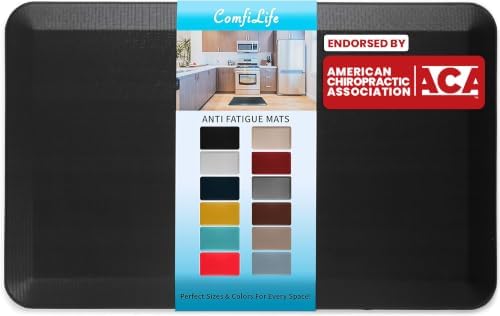
2. ComfiLife Anti-Fatigue Mat — Best Budget Pick
- Exceptional Comfort Anti Fatigue Mat: ComfiLife kitchen mats for floor enhance comfort while standing. It is professiona…
- Premium Quality Construction: The ComfiLife cushioned mat core is made of 3/4 thick, high-density memory foam that reduc…
- Multi-use Floor Mat: The ComfiLife standing pad is exceptional for your office while standing at your desk, the kitchen …
Key Specs
- Dimensions: 20″ x 39″ x 3/4″
- Thickness: 3/4″ (19mm) memory foam
- Material: Polyurethane memory foam
- Weight: ~3.5 lbs
- Colors: Black (multiple sizes available)
Who this is for: Anyone who wants a no-nonsense, well-reviewed anti fatigue standing mat without paying premium-mat prices.
The ComfiLife is one of the most recommended flat anti-fatigue mats on Amazon, and the specs explain why. On paper, the 3/4″ memory foam hits the sweet spot — thick enough to relieve real pressure, not so thick that you feel like you’re standing on a trampoline. It’s a flat mat, which some people actually prefer over the terrain-style Topo: predictable surface underfoot, easy to walk on, and it looks like a proper floor mat rather than a piece of art installation.
The beveled edges are a nice touch. They create a gentle slope rather than a hard wall at the edge, which means you can shuffle your feet to the side without catching your toe on a sharp foam cliff. Minor thing, but after you trip on your mat once at 9am you’ll appreciate the bevels.
Owners generally report that the ComfiLife feels great for the first 2–3 hours of standing, but as a flat mat it can’t match the active-circulation effect of terrain mats. For most people working from home who stand for, say, 2–3 hours per day, that distinction doesn’t matter — the pressure relief is real and your feet will be noticeably happier than they would be standing on hardwood or tile.
Durability is solid for the price. Owner reviews of many cheaper foam mats mention compression around the heel strike zone within a few months, while ComfiLife owners tend to report much longer daily use before any noticeable flattening. Reviewers also say the non-slip bottom stays put on both hardwood and tile.
What stands out:
- Owners rate it comfortable for 2–3 hour standing sessions, at a price that doesn’t hurt
- Beveled edges are thoughtfully designed — no toe-stub moments
- Non-slip backing that reviewers say stays put on wood and tile floors without curling
- Memory foam responds to foot heat and molds slightly to your stance over time
What could be better:
- Flat surface means you need to consciously shift your weight to get the full fatigue-reduction benefit
- Owners report some compression at heel contact points after extended hard daily use
- Doesn’t come in a wide color selection (mainly black) if you have a specific aesthetic going on
Bottom line: The best anti fatigue standing mat for someone who wants real comfort without overthinking it. At a budget price, it covers most of what a premium mat offers for a fraction of the Topo’s cost.
3. Vari Standing Mat — Best for Home Office Feel
- Compact Ergonomic Mat – Enhance your standing desk experience with our compact, anti-fatigue mat. Perfectly fitting unde…
- Superior Desk Accessory – Our rubber floor mats are the ultimate accessory for your sit-stand desk. The non-slip, cushio…
- Durable and Supportive – Designed with heavy-duty rubber, our mat offers long-lasting support. Easily cleaned with warm …
Key Specs
- Dimensions: 36″ x 24″
- Thickness: 5/8″ high-density foam core
- Material: Heavy-duty rubber shell, high-density foam interior
- Warranty: 1-year full replacement (when sold by Vari)
- Weight: ~6 lbs
Who this is for: Home office workers who want a mat from an established standing desk brand that feels premium underfoot and looks clean at a desk.
Vari (formerly VariDesk) is one of the better-known standing desk companies, and their standing mat reflects that brand heritage. It comes across as more “office furniture” than “Amazon accessory” — reviewers describe the rubber exterior as firm and confident underfoot, owners say the mat lies completely flat the first time you unroll it (no flipping over and weighting it for 24 hours like some foam mats require), and the wide 36×24″ footprint gives you plenty of room to stand, shift, and shuffle without running out of mat.
The 5/8″ high-density foam core is slightly thinner than the ComfiLife’s 3/4″ memory foam, a difference reviewers who’ve compared the two say is noticeable. However, the tradeoff is firmness: the Vari feels more stable underfoot, which some people strongly prefer. If you find memory foam mats a bit too squishy and unstable, the Vari’s firmer feel will suit you better.
Owners praise the wide beveled no-curl edges and report that the Vari lies flat reliably over time, which is actually a problem with some cheaper mats that start curling at the corners after a few months. For a home office where the mat is always visible, that matters.
The one real downside is that the 5/8″ thickness doesn’t deliver quite the same pressure relief for very long standing sessions. Some owners who stand for long stretches say they start to feel the floor more than they would on a thicker mat like the ComfiLife or Topo. For 1–3 hour standing sessions, it’s a strong choice. For marathon standing days, I’d reach for the other options.
What stands out:
- Premium look, and owners say it lies flat from day one with no flop or curl
- Wide 36×24″ surface gives genuine room to move; suits two-monitor or wide-desk setups
- Firm, stable feel appeals to people who find memory foam too squishy
- 1-year full replacement warranty from Vari is a nice assurance
What could be better:
- 5/8″ thickness means less cushioning than 3/4″ competitors over very long standing sessions
- It’s priced higher than the ComfiLife despite being thinner — you’re partly paying for the brand name
- Available mainly in black; no color variety
Bottom line: A strong pick if you care about a mat that looks polished in a real office setting and you typically stand 1–3 hours a day. The Vari Standing Mat is reliable, well-built, and wide enough to feel like a proper ergonomic investment.
4. Amazon Basics Anti-Fatigue Standing Mat — Best Value
- Floor mat for reducing the discomfort and fatigue caused by standing on a hard floor for an extended period of time
- Includes a black rectangular floor mat made of textured foam for cushioning comfort; stain and abrasion resistant
- Conforms to the contours of the foot; provides support for feet, knees, and legs
Key Specs
- Dimensions: 20″ x 36″ x 0.6″
- Thickness: 0.6″ (15mm)
- Material: Textured foam, stain and abrasion resistant
- Colors: Black
- Weight: ~2.5 lbs
Who this is for: Anyone new to standing desks who wants to try an anti fatigue standing mat before committing to a premium option, or anyone with a very light standing habit (1 hour/day or less).
As the lowest-priced mat here, the Amazon Basics mat is the entry point for this category, and it earns that spot by being genuinely functional at its price. Owners describe the foam as decent, the non-slip backing as effective, and the edges as non-curling. For a casual standing desk user — maybe someone who stands for 30–60 minutes in the morning and another 30 in the afternoon — this mat is more than adequate.
The honest limitation is the 0.6″ thickness. That’s on the thinner end for a standing mat; owners often mention feeling the hardness of the floor beneath it more than they would with a 3/4″ mat during longer sessions. The material is also textured foam rather than memory foam, so it doesn’t mold or adapt to your feet — you’re getting basic cushioning, not a dynamic response.
That said, the Amazon Basics mat has something the premium options don’t: zero buyer’s remorse risk. If you’re not sure whether you’ll stick with standing desk use, spending a modest amount to find out is a reasonable bet. And honestly, if you stand for 30–60 minutes and you’re not dealing with serious foot or back issues, this mat does its job without complaint.
What stands out:
- Its budget price makes it accessible for anyone who wants to try the category without risk
- Non-slip backing and non-curling edges — the basics are solid
- Stain and abrasion resistant surface wipes clean easily
- Light enough to move between rooms easily (2.5 lbs)
What could be better:
- 0.6″ thickness isn’t enough for serious all-day standing use; owners report feeling the floor during longer sessions
- No memory foam or terrain features — purely passive cushioning
- Compression happens faster than thicker mats; according to owner reviews, it typically lasts around a year or more of daily use
Bottom line: The right starting mat if you’re not yet sure how much you’ll actually stand. Don’t expect it to last forever under heavy use, but for occasional or light standing sessions, it does exactly what an entry-level mat should.
How to Choose an Anti Fatigue Standing Mat: What Actually Matters
Thickness Matters More Than You Think
Most people buying their first anti fatigue standing mat get pulled toward whatever looks thickest. That instinct is mostly right, but the material matters just as much as the number. A 3/4″ polyurethane foam mat (like the ComfiLife) outperforms a 1″ basic EVA foam mat in real pressure relief because polyurethane has better rebound properties — it springs back instead of compressing dead under your feet.
For most standing desk users who stand 2–4 hours a day, 3/4″ is the sweet spot. Under 1/2″ and you’ll feel the floor. Over 1″ and you start to feel slightly unstable, which creates a different kind of fatigue. The exception is terrain-style mats like the Topo — the raised sections effectively add more cushioning where your arch needs it most.
Flat vs. Not-Flat: The Real Debate
When you’re choosing an anti fatigue standing mat, the flat vs. not-flat question matters more than almost any other spec. Flat mats are simpler, wider, and easier to walk on. If you pace, fidget, or shift around a lot while working, a flat mat is less likely to catch your feet. They look cleaner under a desk and are generally less expensive.
Not-flat terrain mats (the Topo being the prime example) do more for active fatigue prevention. The subtle landscape forces your feet and calves to make micro-adjustments constantly, which keeps circulation moving in a way that passive flat foam can’t replicate. The tradeoff is that they have a smaller flat zone, they look unusual, and they take a few days to adapt to.
My honest take: if you stand for 3+ hours a day and fatigue or back pain is a real problem, the terrain mat is worth the adjustment period. If you stand for 1–2 hours and mainly want comfort underfoot, a flat 3/4″ mat is the right answer and you don’t need to pay premium-mat money to get it.
Size and Your Standing Desk Setup
The standard size for an anti fatigue standing mat is around 20″ x 39″ (the long format). This gives you room to stand wide, shift your weight side to side, and occasionally do a light calf raise or stretch without stepping off the mat. For most single-monitor desks, this is the right size.
Wider format mats (like the Vari at 36″ x 24″) trade length for width, which works well for wide desk setups or dual-monitor configurations where you stand more laterally across your workspace.
A quick note: if you’re still deciding between sit-stand desk options, check out our FlexiSpot vs FEZIBO standing desk comparison for context on the desk side of the equation.
Price vs. Value Breakdown
When budgeting for your anti fatigue standing mat, here’s how the tiers break down. Budget: Amazon Basics territory — fine for light use, not for all-day standing. According to owner reviews, a mat at this tier typically lasts around a year or more of daily use.
Upper budget to mid-range: Where the real value lives. The ComfiLife and the Vari sit in this range and deliver genuine quality. This is where most home office workers should land.
Premium: Terrain mats like the Ergodriven Topo. Worth it if you stand seriously — i.e., 3+ hours daily. If you’re paying premium prices for a mat, your standing habit needs to be real.
Floor Type Considerations
One thing people forget to check: whether the mat works on their floor surface. If you have carpet, you want a mat with a flat rubber backing (the ComfiLife works well on carpet). On hardwood or polished tile, a textured rubber bottom is better to prevent micro-sliding. Most of the mats here work on both, but it’s worth confirming before you buy.
For more on building out your desk surface itself, take a look at our Best Desk Mat for Home Office 2026 — it covers the surface pad that sits on top of your desk, which is a different product but a natural companion to an anti-fatigue floor mat.
Related Home Office Guides
- Best Standing Desk Converter — what you stand at
- Best Under Desk Treadmill — go from standing to walking
- Best Ergonomic Mouse — protect wrists while standing
Frequently Asked Questions
Do anti-fatigue mats really work for standing desks?
Yes — a quality anti fatigue standing mat is one of the most impactful ergonomic changes you can make to your setup. Ergonomics guidance generally recommends anti-fatigue mats for prolonged standing, because a cushioned surface encourages subtle micro-movements in your feet and calves that help keep blood circulating. The idea is that your muscles make small, continuous contractions that prevent the pooling and static load that makes standing on hard floors uncomfortable. That said, no mat eliminates fatigue completely; they reduce and delay it.
How thick should an anti-fatigue mat be for a standing desk?
The sweet spot is 3/4″ (about 19mm) for daily use. Thinner than 1/2″ and you feel the floor too much; thicker than 1″ and you start feeling slightly unstable. Material matters too — 3/4″ polyurethane foam outperforms 1″ basic EVA foam because polyurethane has better rebound and doesn’t compress dead under your weight.
What size anti-fatigue mat do I need for a standing desk?
For a single-monitor setup, 20″ x 39″ is the standard and covers most people well. For a wide or dual-monitor desk, a wider format like 24″ x 36″ or larger gives you more lateral room to shift. Avoid going smaller than 20″ x 30″ for a standing desk — you’ll feel constrained.
What’s the difference between flat and not-flat anti-fatigue mats?
Flat mats provide passive cushioning — they soften the floor surface and reduce direct pressure on your feet. Not-flat terrain mats (like the Ergodriven Topo) actively encourage your feet to micro-adjust, which keeps your calf muscles working and blood circulating continuously. Terrain mats are better for fatigue prevention; flat mats are simpler and better if you move around a lot.
Can an anti-fatigue mat help with back pain?
Indirectly, yes. Back pain from standing often comes from static posture — staying locked in the same position because the floor is hard. Anti-fatigue mats encourage subtle weight shifting and movement, which prevents the static muscle tension that travels up from your feet to your lower back. They’re not a cure for back problems, but they remove one significant contributor to the problem.
How long do anti-fatigue mats last?
A quality high-density foam mat (ComfiLife, Vari) generally holds up for several years of daily use before developing dead zones, according to owner reviews. Cheaper foam mats typically last around a year or more of daily use before they start losing thickness. Terrain mats like the Topo tend to last longer because the foam is thicker and the pressure is more distributed. Compression under the heel contact zone is usually the first sign a mat needs replacing.
Are anti-fatigue mats worth it in 2026?
Yes, if you stand for 2+ hours daily, absolutely. Ergonomics guidance generally supports using one, and the price of entry for a quality budget mat is low relative to the daily comfort difference. The only scenario where I’d say skip it: if you stand for less than 30–45 minutes a day, the benefit is marginal and a good pair of shoes might serve you better.
Can you use an anti-fatigue mat on carpet?
Most can, but it’s not ideal. On carpet, the mat sits on a slightly unstable surface, which reduces the cushioning effect since the carpet itself absorbs some of the compression. If you have carpet, choose a mat with a flat rubber backing (not a textured or spiked bottom, which grips hard floors well but slides on carpet fiber). The ComfiLife performs acceptably on carpet.
What’s the best material for an anti-fatigue mat?
Polyurethane foam is the best all-around material for standing desk mats. It has better rebound, higher density, and longer lifespan than EVA or standard foam alternatives. PVC-based mats exist but often off-gas unpleasant chemical smells and are less environmentally friendly. Memory foam adds a contouring element but can feel mushy and unstable if the density is too low.
How do you clean an anti-fatigue mat?
Most foam standing mats clean with a damp cloth and mild soap. Avoid soaking them or putting them in a washing machine — water can damage the foam interior even if the exterior looks intact. Let any mat dry completely before standing on it again after cleaning.
Final Verdict
The right anti fatigue standing mat for most people who stand seriously at their desk is the premium-priced Ergodriven Topo — the terrain design does something flat mats simply can’t replicate over a long workday. If the price is a stretch or you stand less than 3 hours daily, the budget-priced ComfiLife covers most of what the Topo offers for a fraction of the cost and is my go-to recommendation for anyone who wants a quality flat mat without the premium. The lowest-priced Amazon Basics mat is a genuine “try before you commit” starting point.
One thing owners say again and again: once they’ve worked a full day with a proper anti fatigue standing mat underfoot, standing on bare hardwood or tile feels immediately wrong. That’s how you know the mat is doing its job.
- Floor mat for reducing the discomfort and fatigue caused by standing on a hard floor for an extended period of time
- Includes a black rectangular floor mat made of textured foam for cushioning comfort; stain and abrasion resistant
- Conforms to the contours of the foot; provides support for feet, knees, and legs
- Compact Ergonomic Mat – Enhance your standing desk experience with our compact, anti-fatigue mat. Perfectly fitting unde…
- Superior Desk Accessory – Our rubber floor mats are the ultimate accessory for your sit-stand desk. The non-slip, cushio…
- Durable and Supportive – Designed with heavy-duty rubber, our mat offers long-lasting support. Easily cleaned with warm …
- CRITICAL STANDING DESK ACCESSORY – If you have a standing desk, you need a standing desk mat. Why? Because with no mat (…
- THE BEST STANDING DESK MAT – Topo is the first ever mat designed specifically for standing desks. This isn’t just a chea…
- FEEL BETTER AT WORK AND AFTER – With Topo, you’ll move more while you stand, without even thinking about it. This will h…
- Exceptional Comfort Anti Fatigue Mat: ComfiLife kitchen mats for floor enhance comfort while standing. It is professiona…
- Premium Quality Construction: The ComfiLife cushioned mat core is made of 3/4 thick, high-density memory foam that reduc…
- Multi-use Floor Mat: The ComfiLife standing pad is exceptional for your office while standing at your desk, the kitchen …
Last updated: May 2026 | Prices subject to change.
Questions about any of these picks? Get in touch via our contact page.
Pingback: Best Laptop Cooling Pad For Students In 2026
Pingback: Best Standing Desk Converter In 2026: 3 Picks For Any Budget
Pingback: FlexiSpot Vs Fezibo 2026 — Which Standing Desk Wins?
Pingback: Best Under Desk Treadmill For Home Office In 2026