
This post contains affiliate links. As an Amazon Associate, I earn from qualifying purchases at no extra cost to you.
My Top Pick — Kasa EP25 (4-Pack)
Looking for the best smart plugs energy monitoring 2026? If you want one smart plug that just works — with your iPhone, your Alexa, your Google Assistant, and your electric bill — the Kasa EP25 is the one to get. Owners consistently report running these for months on desktops, monitors, lamps, and space heaters without missing a beat. For a modest per-plug cost in the 4-pack, you’re getting energy monitoring, HomeKit support, and a strong reputation among smart home reviewers. That’s not nothing.

- 【Apple Homekit Support】This Apple HomeKit compatible smart plug fully integrates into your Apple ecosystem, just ask Sir…
- 【Energy Monitoring & 15A Max Load】Use the smart Wi-Fi home plug to monitor your connected device’s energy usage in real-…
- 【Super Easy Setup】Enjoy an extremely easy and quick setup process with this Amazon Frustration-Free Setup (FFS) & Google…
Best Smart Plugs with Energy Monitoring — Quick Comparison
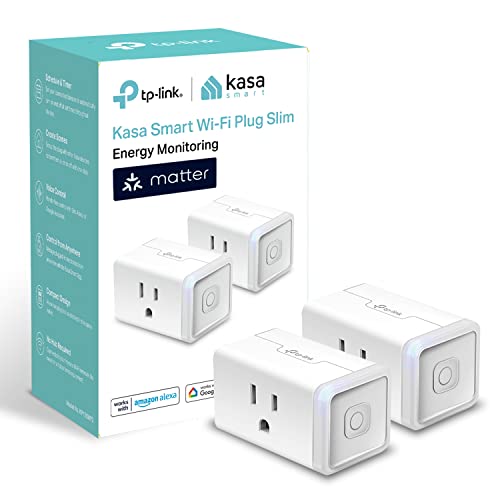


| Product | Price Tier | Best For | Matter |
|---|---|---|---|
| Kasa EP25 4-pack | Premium | Best overall + HomeKit | No |
| Kasa KP125M Matter | Mid-range | Matter ecosystem builders | Yes |
| Tapo P115 4-pack | Budget | Tightest budget, lowest per-plug cost | No |
| Tapo P110M Matter | Budget | Matter on a budget | Yes |
Reviews — Detailed Breakdown
1. Kasa EP25 4-Pack — Best Overall
- 【Apple Homekit Support】This Apple HomeKit compatible smart plug fully integrates into your Apple ecosystem, just ask Sir…
- 【Energy Monitoring & 15A Max Load】Use the smart Wi-Fi home plug to monitor your connected device’s energy usage in real-…
- 【Super Easy Setup】Enjoy an extremely easy and quick setup process with this Amazon Frustration-Free Setup (FFS) & Google…
Key Specs
- Load: 15A / 1,800W max
- Connectivity: 2.4GHz Wi-Fi only
- Compatibility: Apple HomeKit, Alexa, Google Home, SmartThings
- Energy monitoring: Real-time watts + historical kWh
- Design: Compact — won’t block adjacent outlet
- Warranty: 2 years (UL certified)
Who this is for: Anyone searching for the best smart plugs energy monitoring 2026 — starting with the most reliable smart plug available without overthinking it — especially HomeKit users and people who want genuine energy data, not rough estimates.
Plug the EP25 into a desktop computer setup and it can reveal surprises fast — an idle gaming PC drawing 47 watts continuously, for example, works out to about $50 per year in standby power alone. The Kasa app shows real-time wattage and lets you set a schedule to cut power at midnight automatically. Owners report setup taking under three minutes — open the Kasa app, hold the button until the LED blinks, and it’s done. No hub, no extra steps.
The compact design is genuinely useful. On paper, the EP25 is slim enough to sit in a duplex outlet with limited clearance without blocking the second socket. That sounds minor until you’ve owned a smart plug that covers the other outlet. Reviewers often mention the build quality feels solid — not flimsy plastic — and owners consistently report months of 24/7 use with few or no connection drops.
What makes the EP25 stand out from everything at this price is the HomeKit integration. Most budget plugs support Alexa or Google, then tack on HomeKit as an afterthought that requires a separate hub. The EP25 works natively with Apple Home — you just scan the HomeKit code on the side, and it appears in your Home app in seconds. Owners consistently report that Siri control is quick, automations stick, and it rarely drops off HomeKit.
What we like:
- Owners consistently report reliable schedules over long-term use — the benchmark that matters
- HomeKit + Alexa + Google + SmartThings all work natively — no ecosystem lock-in
- Real-time watts plus historical kWh — detailed enough to actually act on
- Compact form factor: two plugs fit in a standard duplex outlet side by side
- No subscription required for any feature, ever
What could be better:
- 2.4GHz Wi-Fi only — if your mesh router blends bands, you may need to temporarily separate them during setup
- No Matter certification — automations are cloud-dependent (though manual control always works locally)
- The Kasa app is good but not as polished as Apple’s Home app for automation building
Bottom line: This is the easiest smart plug to recommend to almost anyone. It works with every major platform, the energy data is detailed and easy to read, and verified owner reviews back up its reliability.
2. Kasa KP125M Matter — Best for Matter Ecosystem
- 【Matter-Compatible Smart Home Integration】Works with Matter-certified platforms such as Apple Home, Amazon Alexa, Google…
- 【Matter: Smooth LAN Control】All Matter-certified devices in your local area network (LAN) will work smoothly even when y…
- 【Energy Monitoring】Tracks energy usage over time to help you understand consumption patterns and make informed decisions…
Key Specs
- Load: 15A / 1,800W max
- Connectivity: Matter over 2.4GHz Wi-Fi
- Compatibility: Apple Home, Alexa, Google Home, SmartThings (all via Matter)
- Energy monitoring: Real-time + historical
- Certifications: Matter, UL certified
Who this is for: Anyone building a new smart home in 2026 who wants future-proof devices, or HomeKit users who want automations that run even when the internet goes down.
The KP125M is what happens when TP-Link takes the EP25 and adds Matter certification. On paper, the difference from non-Matter plugs is immediate. Owners report setup taking under 60 seconds: scan the QR code in Apple Home, Google Home, or the Kasa app, and the plug appears instantly on every platform simultaneously.
The big real-world advantage of Matter is local control. When a router reboots, cloud-dependent non-Matter plugs can go offline until they reconnect. The KP125M is designed to keep running its schedules without interruption — processing commands directly on your local network, not routing through TP-Link’s servers first. If you run automations that need to work reliably, that difference matters more than it sounds.
What we like:
- Matter certification means it works with every platform today and any new one in the future
- Local control: automations run even without internet connection
- Real-time and historical energy monitoring on par with the EP25
- Widely owned and well reviewed — one of the most established Matter plugs available
What could be better:
- Only available in 2-pack on the main listing, raising per-plug cost vs. EP25 4-pack
- No Bluetooth pairing mode — setup requires Wi-Fi from the start
Bottom line: If you’re starting a smart home from scratch in 2026, the KP125M is the smarter long-term investment. Matter compatibility means you won’t need to replace these when the next platform shift happens. It earns a spot on any best smart plugs energy monitoring 2026 list.
3. TP-Link Tapo P115 4-Pack — Best Budget Pick
- 【Insightful Energy Tracking】Track your plug’s energy use with clear and easy-to-understand statistics and intuitive char…
- 【Estimate Your Energy Bill】 Enhance energy management by integrating with billing systems for clear cost visualization (…
- 【Smart Charging for Devices】Automatically cuts power once your device reaches the low-battery limit you set, preventing …
Key Specs
- Load: 15A / 1,800W max
- Connectivity: 2.4GHz Wi-Fi
- Compatibility: Alexa, Google Home, Samsung SmartThings
- Energy monitoring: Real-time + bill estimation feature
- Price tier: Budget (lowest per-plug cost in this roundup)
Who this is for: Budget-conscious buyers who want energy monitoring across multiple rooms — especially Alexa and Google Home users.
The P115 is a natural fit for kitchen duty, monitoring things like a coffee maker, a slow cooker, or a countertop blender. With the lowest per-plug cost in this roundup, it’s hard to argue with the value. The Tapo app has one feature that most competitors skip: bill estimation. You enter your electricity rate — say, $0.14 per kWh — and the app converts raw usage into actual dollar amounts. At that rate, an older coffee maker idling at around 15W costs roughly $18 per year just in standby power. That adds up fast.
The mini form factor is genuinely smaller than the EP25. Verified owner reviews point to long-term stability with few connection drops. The honest trade-off: no HomeKit support. If you’re deep in the Apple ecosystem, go with the EP25 or KP125M. If you’re Alexa or Google Home only, the P115 is the best value available.
What we like:
- Bill estimation feature converts kWh into actual dollar costs — uniquely useful
- Mini form factor: measurably smaller than most competitors
- Consistently strong owner ratings and steady popularity
- Bluetooth setup avoids the Wi-Fi network switching headache
What could be better:
- No Apple HomeKit support
- No Matter certification — relies on cloud for automations
Bottom line: The best value-per-plug for energy monitoring in 2026. If HomeKit isn’t a requirement, the P115 4-pack is the obvious recommendation.
4. Tapo P110M — Best Matter Budget Plug
- 【Matter-Certified】Matter-certified devices, regardless of brand, can work together and are compatible with most major sm…
- 【Insightful Energy Tracking】 Monitor your energy consumption with in-depth statistics and clear visuals, helping you opt…
- 【Estimate Your Energy Bill】 Enhance energy management by integrating with billing systems for clear cost visualization (…
Key Specs
- Load: 15A / 1,800W max
- Connectivity: Matter over 2.4GHz Wi-Fi
- Compatibility: Apple Home, Alexa, Google Home, SmartThings (all via Matter)
- Energy monitoring: Real-time + bill estimation
Who this is for: Apple Home users who want energy monitoring but can’t justify the EP25’s price, or anyone who wants Matter at the lowest possible cost.
The P110M is the compromise most people don’t realize exists: Matter certification plus energy monitoring at a price that sits between the P115 and KP125M. Setup is one QR code scan in any Matter-compatible app. The bill estimation feature carries over from the P115 — real dollar amounts instead of raw kWh numbers are more useful for most people.
What we like:
- Matter certified at one of the lowest prices in the category
- Energy monitoring with bill estimation in dollars, not just watts
- Works with Apple Home natively without a hub or bridge
- Local control via Matter means automations run without internet
What could be better:
- Higher per-plug cost than the P115 4-pack if you’re outfitting several rooms
- Matter-over-Wi-Fi, not Thread — less efficient than Thread-native implementations
Bottom line: The P110M hits a sweet spot nothing else quite covers: Matter certification, energy monitoring, and an approachable price.
How to Choose a Smart Plug with Energy Monitoring
Does Energy Monitoring Actually Save Money?
Short answer: yes, if you actually look at the data. A home office setup you assume idles at 150W can easily turn out to be 240W once a plug like the Kasa EP25 measures it — an old monitor power brick alone can draw 45W in standby. Over a year, that’s roughly $55 paid for nothing, so the plug can pay for itself within a few months. The best smart plugs with energy monitoring in 2026 can reveal real savings quickly.
The more useful framing: energy monitoring plugs don’t save money passively — they show you where to save money. A plug tracking your entertainment center will show you whether turning off the TV properly actually matters (it usually does). One on your gaming PC will reveal whether sleep mode is as efficient as you thought (often it isn’t). Check the data and act on it.
Matter vs. Non-Matter: Does It Actually Matter in 2026?
Matter is the smart home standard backed by Apple, Amazon, Google, and Samsung. Devices with Matter certification work natively on all four platforms without a bridge or extra setup. They also support local control — automations run even when your internet goes down. Non-Matter plugs (like the EP25 and P115) rely on cloud servers for automations, which works 99%+ of the time but not all the time. If you’re starting fresh in 2026, go Matter. If you already have a working setup that fits your ecosystem, you don’t need to change anything. When choosing the best smart plugs energy monitoring 2026, Matter vs non-Matter is often the defining decision.
Which Ecosystem Are You Already In?
This is the most important question most buying guides skip. Heavy Apple HomeKit user? Go Kasa EP25 or KP125M — the Tapo P115 doesn’t support HomeKit at all. Alexa or Google Home only? Tapo P115 is the best value, full stop. Mixed household or future-proofing? Any Matter-certified option works. Want to monitor multiple rooms cheaply? Tapo P115 4-pack is unbeatable per plug. For the best desk setup, also check our picks for best monitor light bars and best USB-C hubs.
See full specs on Kasa’s official product page
Related Smart Home Guides
- Best Smart Bulbs for Alexa — build out the ecosystem
- Best Smart Thermostat Without a C-Wire — the biggest energy saver
- Best Robot Vacuum Under $200 — more automation on a budget
Frequently Asked Questions
Do smart plugs with energy monitoring require a subscription?
None of the plugs in this guide require a subscription for energy monitoring. The Kasa app, Tapo app, and all associated platforms provide full energy data, scheduling, and history completely free.
What’s the difference between the Kasa and Tapo brands?
Both are made by TP-Link. Kasa is the older line, optimized for Alexa, Google Home, and HomeKit. Tapo is TP-Link’s newer brand, with a more modern app and better Matter support. You can control both brands from the Tapo app. If you’re buying new in 2026, Tapo’s Matter options are worth considering first.
Can smart plugs handle high-power appliances like space heaters?
All the plugs in this guide are rated 15A / 1,800W — enough for most lamps, fans, and small appliances. A standard 1,500W space heater will work fine. However, avoid plugging refrigerators, washing machines, or air conditioners into smart plugs unless the plug is specifically rated for motor-driven loads — these can draw 2-3x their listed wattage at startup.
Are the best smart plugs energy monitoring 2026 worth it?
Yes. At budget-friendly per-plug prices, the cost is small compared to what you’ll learn — and likely save — by seeing your actual usage. The Tapo P115 4-pack makes it easy to start with multiple devices without a big upfront investment.
Final Verdict
Planning for outages too? Energy-monitoring plugs show exactly how many watt-hours your fridge, router and freezer use — the numbers you need to size a backup battery. See our guide to the best solar generator for RV trips for portable power stations that can run those same appliances.
The Kasa EP25 is the best smart plug with energy monitoring in 2026 — reliable, detailed energy data, and native HomeKit support alongside Alexa, Google Home, and SmartThings. For Matter purists building a new ecosystem, the Kasa KP125M is the smarter long-term investment. Budget buyers who don’t need HomeKit should go straight for the Tapo P115 4-pack — with the lowest per-plug cost here, it’s the best value available. And if you want Matter certification at the lowest price, the Tapo P110M covers that gap perfectly. All four are among the top best smart plugs energy monitoring 2026 — pick based on your ecosystem.
No layout selected.Last updated: May 2026 | Prices subject to change.
Questions about any of these picks? Get in touch via our contact page.
Pingback: Best Smart Light Switches No Neutral Wire 2026
Pingback: Best Security Camera System For Home In 2026 – Tested & Reviewed
Pingback: Best Smart Thermostat Without A C-Wire In 2026
Pingback: Best Video Doorbell Without Subscription In 2026 | Pickitech